






Industries
Website design for industries we have actually worked in.
Tech Conversion provides website design for industries with their own buyers and their own rules, and runs the search, AI search and paid campaigns that bring people to the site, for businesses in India, the UAE and the USA. We have worked in 9 sectors: Technology & IT services, SaaS & digital platforms, Ecommerce & retail, B2B & enterprise, Healthcare & wellness, Education & training, Real estate & hospitality, Legal & professional services and B2C & consumer brands.
Not a list of markets we would accept work from. These are the ones where we can name who signs, show the rules the work is done under, and point at something we built. In each one, we research the sector before we design anything for it.
Pick your sector
Where we work
Each one opens a page with who buys, what goes wrong on sites in that sector, the rules it works under and what we do about it.
 Technology & IT servicesTechnical buyers judge a vendor's site the way they judge a vendor.Open
 SaaS & digital platformsThe marketing site has one job: get a qualified visitor into the product.Open
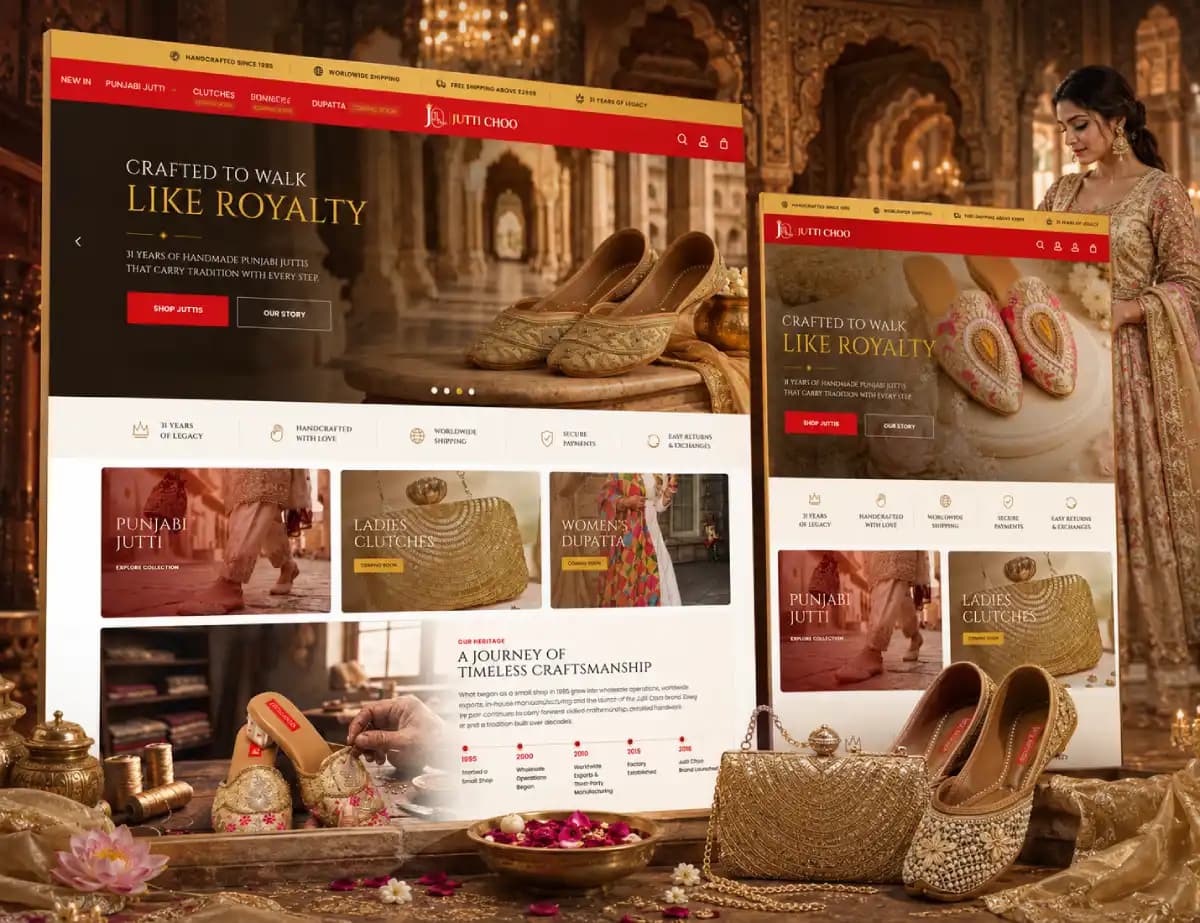 Ecommerce & retailMost stores do not have a traffic problem.Open
 B2B & enterpriseNobody signs a six-figure contract from a web page.Open
 Healthcare & wellnessA patient choosing a clinic is anxious, not shopping.Open
 Education & trainingEvery prospective student is asking the same three things before anything else: what will it cost, how long will it take, and what happens afterwards.Open
 Real estate & hospitalityPeople decide about a property or a stay visually and fast.Open
 Legal & professional servicesClients hire a firm they trust with something that frightens them.Open
 B2C & consumer brandsA consumer brand is judged in about a second, mostly on a phone.Open
Why it changes the work
What the sector actually changes
Put as an argument you can disagree with, because the version stated as a boast is worth nothing to somebody deciding whether to pay for it.
The person who signs is a different person
A technical lead, a managing partner, an admissions head and a procurement officer do not read the same page the same way. Sector work is mostly about who the page is written for, and that decision is made before a single word of it.
Some sectors do not get to choose
An advocate's site in India cannot carry a testimonial or a success claim at all under the Bar Council rules. A registered property project cannot be advertised without its registration number. Neither is a style preference, and neither is something you find out halfway through a build.
The search language belongs to the sector
Buyers search the symptom and the term of art, not the service name a firm gave its own offer. Getting that wrong produces a site that ranks for what we call the work rather than for what anyone is looking for.
Somebody pays for the learning either way
A firm new to a sector learns it during your project, on your budget and your timeline. That is a real cost, and the honest version of this argument is not that we know everything, it is that in these sectors the learning is already done.
What applies everywhere
The services underneath every sector
The work itself is the same catalogue in every sector. It is linked rather than re-explained here, because each service already has a page with what it includes, what it costs and how it runs.
The rules you work under
Regulators and frameworks, sector by sector
One row per sector, showing the first regulator or framework its own page names, and what that one changes about a website or a campaign. Each sector page carries the rest, linked to the source. This is not legal advice.
| Sector | First rule named on its page | What it changes |
|---|---|---|
| Technology & IT services | Digital Personal Data Protection Act, 2023↗ | Most IT services firms process client data as a processor. The privacy policy and any enquiry form have to say what is collected and why, and consent to marketing has to be a recorded, separate choice. |
| SaaS & digital platforms | Digital Personal Data Protection Act, 2023↗ | A platform holding user accounts is handling personal data in its own right and on behalf of its customers. Signup forms, trial forms and product analytics have to state the purpose of what they collect, and consent to marketing has to be a separate, recorded choice from the consent needed to run the service. |
| Ecommerce & retail | Consumer Protection (E-Commerce) Rules, 2020↗ | The store has to display the seller's identity and address, the total price with its breakdown, the country of origin where it applies, the return, refund and exchange policy, and grievance officer contact details. These are page elements with their own place in the template, not a line in the footer. |
| B2B & enterprise | Digital Personal Data Protection Act, 2023↗ | Contact details taken from an enquiry form, a gated document or an event list are personal data. The purpose has to be stated where it is collected, and consent to be added to a marketing programme has to be separate from consent to be contacted about the specific enquiry made. |
| Healthcare & wellness | Drugs and Magic Remedies (Objectionable Advertisements) Act, 1954↗ | Prohibits advertising that suggests a treatment will diagnose, cure or prevent the conditions listed under it. This decides what a treatment page, a campaign and a testimonial may say about results, and it rules out patient stories framed as cures. |
| Education & training | University Grants Commission notices on recognition↗ | The commission publishes lists of institutions that are not recognised and has repeatedly acted over prospectuses and websites claiming degrees or recognition an institution does not hold. Recognition may be stated only where it is held, named with the body that granted it. |
| Real estate & hospitality | Real Estate (Regulation and Development) Act, 2016↗ | A registered project cannot be advertised without its registration number, and the advertisement has to agree with the registered particulars, including carpet area, approved plans and the declared completion date. This applies to the website, the landing page and the ad creative equally. |
| Legal & professional services | Bar Council of India Rules, Part VI, Chapter II, Rule 36↗ | An advocate may not advertise or solicit work, directly or indirectly. Since the 2008 amendment the rule permits a website carrying only the advocate's name, address, telephone number, email, enrolment number, professional and academic qualifications and areas of practice, with a declaration that the particulars are true. That decides the whole site: no success claims, no client lists, no testimonials, no comparative language. |
| B2C & consumer brands | ASCI influencer guidelines↗ | A material connection has to be disclosed prominently and upfront, in a label the average viewer will notice, on the platform where the post appears. The brand is answerable for what a paid creator claims about the product, which makes the brief part of the compliance, not part of the creative. |
9 sectors, one rule each. The sector pages name the others, including the standards that are not law and are asked about anyway, and every one of them links to the body that publishes it so you can check us rather than trust us.
From these sectors
The work we can show you
Live sites with a written case behind them, filed under the sectors they genuinely belong to. Sectors with nothing written up yet are not listed here at all.
A case appears under every sector it belongs to rather than being filed once. The before and after pairs, which are sites we rebuilt without a written case behind them, sit on the sector pages and on the comparison page.
Who we have worked with
42 clients, by their marks
The marks we hold permission to show, across all of the sectors above. A logo proves a relationship and nothing more, which is why it sits below the work rather than above it.
Who has done this before
Named sector experience
A fair question with no honest answer on this site yet. We record what each person does, not the sectors they have shipped in, and writing a work history for a named colleague is not something to do from memory.
Until it is recorded, the sector pages name the roles that deliver the work and the About page names the people. Ask in the strategy discussion who would actually be on your project and you will get a straight answer.
Reading
6 pieces worth the time
What we have published on the problems that cut across these sectors, rather than a post per sector written to fill a grid.
SearchAEO SEO: Answer Engine Optimisation for AI-driven search visibilityRead it

SearchGenerative Engine Optimisation servicesRead it

DesignThe ultimate guide to conversion-focused web designRead it

SearchTop SEO strategies for a website redesignRead it

DesignMobile-first B2C website design in 2026Read it

B2BThe executive's dilemma: navigating global managed IT servicesRead it
Questions
Asked and answered
What people ask about sector coverage before they ask about the work.
Do you only work in these sectors?
No. These are the 9 we have written up, because in each one we can name who signs, point at the rules the work is done under, and show something we built. Work outside them is taken on, it just does not get a page claiming knowledge we would be acquiring as we went.
What if my sector is not listed here?
Start with the sector closest to how your buyers behave rather than the closest by label. A specialist manufacturer usually buys like B2B and enterprise, a clinic chain like healthcare, a training business like education. If none of them fits, say so in the strategy discussion and we will tell you plainly whether the gap is a problem.
Does sector experience actually matter, or is a website a website?
It matters most where it is not optional. The regulator table on this page is the short version: in several of these sectors what the site is allowed to say is decided before anyone opens a design tool. Where there is no such rule, the value is narrower and honest to state as such, which is knowing what the buyer needs answered and in what order.
Do you take on sector work outside India?
Yes. Tech Conversion has worked with clients in the United Arab Emirates and the United States since it was founded in 2024. The regulatory blocks on the sector pages are written from the Indian position first, so where a project sits under another jurisdiction that part is scoped with the client's own advisers rather than assumed.
How do you learn a sector you have not worked in?
By reading what the sector reads and talking to the people who sell in it, before anything is designed. That means the regulator's own material rather than a summary of it, the questions that come up in the client's sales calls, and the sites their buyers already compare them against. It is slower than starting to design, and it is the part that decides whether the rest is worth doing.
Can you guarantee rankings or leads in my sector?
No, and nobody honestly can. Search engines, AI tools and buyers all decide for themselves. What we promise is the research before the build, a site that follows your sector's rules, tracking from launch, and steady improvement based on what real visitors do.
Is this only website design, or do you handle the marketing as well?
Both, where both are needed. A website on its own is not a growth plan, so the same team can run the search, AI search, paid campaigns and conversion work that bring people to it. If a simple, well-built site is all your business needs, we will say so.
Next step
Start with your own sector
No deck and no pitch. Bring what is not working and we will tell you whether your sector makes it harder, easier or no different.
Insights
The thinking behind the work, in the open.
We write up the problems we had to solve for a client: how answer engines change what a page has to say, and why a redesign that ignores search can cost a year of ranking. Working notes, not filler.
7 published
All writing