





Website development and marketing agency
UI UX design agency for products people give up on.
Tech Conversion is a UI UX design agency for software companies and businesses in India, the UAE and the USA whose products work but lose people halfway, researching with real users before designing the flows, screens and component system your engineers build from.
Interface and experience design for teams whose product works and whose users still cannot find the thing they came for.
- Research with real users
- Flows before screens
- Interface design
- A design system
Typical timelineFour to eight weeks, depending on how many flows and whether research is included.
Who needs this
People reach the thing and stop.
The signups arrive, the feature exists, and somewhere between the two people quietly give up. Nobody complains, because abandoning a product costs nothing. The support inbox stays quiet and the numbers keep falling.
The product works and nobody uses it properly
The feature you spent a quarter on is used by four percent of accounts, and you do not know whether that is the feature or the way it is presented.
Every release makes it more complicated
Things get added and nothing gets taken away. The interface is now a record of every decision anyone made.
Design is decided by whoever argues longest
There is no system and no research, so the loudest opinion wins and the product changes direction with the org chart.
Engineers are designing by default
Not because they want to. Because somebody has to, and there is no design to build from.
- Support answers the same question every week
- People stop at the same screen
- Every new feature makes the interface harder
- Your team argues about design with no way to settle it
What the work is
What is in, and what is not
Said in both directions, so nothing is waiting to be added once the work has started.
Included, every time
- 01Research with real users
We watch people use what exists now. Five sessions finds most of it, and it ends the arguments that opinion cannot.
- 02Flows before screens
The path a person takes, written down and agreed, before anyone opens a design tool. Screens are the output of a flow, not the other way round.
- 03Interface design
The screens themselves, designed at real sizes with real content, including the states nobody remembers: empty, loading, error, too much data.
- 04A design system
Components with their states and rules, so your engineers build from a source rather than from a picture, and the next screen matches this one.
- 05Prototypes you can click
Tested with people outside the team before anything is built, because a prototype is cheap to change and a build is not.
- 06Handover that survives
Specifications, spacing, behaviour and edge cases, in a form a developer can work from without asking.
Not included
- The build itself, which is a separate engagement
- Brand identity, if the logo and palette need redoing
- Copywriting beyond interface text
- Ongoing design support, unless it is scoped
What changes
What you get out of it
For the business, not for the website. What we do is the previous section; this is what it is for.
People finish what they start
The path through the product is deliberate rather than accumulated, and the drop off moves.
Arguments get settled by evidence
Research recordings end a debate faster than any amount of seniority.
Engineers stop guessing
A design system means the answer to how should this behave is written down before it is asked.
The next screen matches this one
Consistency stops being something you police and starts being the default.
What it is held to
Standards and frameworks
Named, published and checkable. These are the frameworks the work is built to and tested against, not badges we claim.
- WCAG 2.2, level AA↗
Contrast, focus order, keyboard operation and the states screen readers announce. Designed in, rather than retrofitted after a procurement question.
- EN 301 549↗
The European harmonised standard, which incorporates WCAG and applies to anyone offering digital services to EU consumers regardless of where they are registered.
- Core Web Vitals↗
Interaction to Next Paint is a design problem as much as an engineering one: what a screen does while it waits is a decision somebody makes.
How it runs
Our UI UX design services, step by step
Six steps, and what each one hands you at the end of it.
- 01
Watch
Sessions with people using what exists, recorded, with the moments they hesitate marked.
You getRecordings and a written list of where people stop.
- 02
Map
The flows as they are, then as they should be, agreed before any screen is drawn.
You getCurrent and intended flows, and what changes between them.
- 03
Design
Screens at real sizes with real content, including empty, loading and error states.
You getThe screens, and the components they are made from.
- 04
Test
A clickable prototype put in front of people who have never seen it.
You getWhat broke, and what changed as a result.
- 05
Systemise
Components, states and rules written up so the build matches the design and the next screen matches both.
You getA design system your engineers can work from.
- 06
Hand over
Specifications and a walkthrough with the people who will build it.
You getFiles, specifications and a recorded session.
- 01Watch. Recordings and a written list of where people stop.
- 02Map. Current and intended flows, and what changes between them.
- 03Design. The screens, and the components they are made from.
- 04Test. What broke, and what changed as a result.
- 05Systemise. A design system your engineers can work from.
- 06Hand over. Files, specifications and a recorded session.
What lands, and what you bring
Deliverables, timeline and what we need from you
You receive
- Research findings, with recordings
- Current and intended user flows
- Designed screens including every state
- A clickable prototype
- A component library with usage rules
- Developer handover documentation
How long
Four to eight weeks, depending on how many flows and whether research is included.
You bring
- Access to real users, or permission to recruit them
- Whoever will build it, in the room at the start
- Existing brand assets
- One person who can decide
What it costs
Priced as a website engagement
Priced as a design engagement. A single flow redesigned costs less than a product wide system, and the strategy discussion settles which one you actually need.
Starts from
₹25,000
$500 if you pay from outside India.
Four to six weeks, longer for a store
All three engagements, side by sideWhat moves the figure
- How many flows
- Whether research is included
- How many states and breakpoints
- Whether a design system is built or extended
A written quote follows the strategy discussion. Nothing is added afterwards that was not named in it.
Where it goes wrong
Common mistakes, risks and pitfalls
The mistakes we see most, including ones we have made. Worth knowing before you buy this from anyone.
Designing screens before flows
A beautiful screen in the wrong place is still the wrong place. The order people move in decides more than any individual screen.
Designing with fake content
Lorem ipsum is always the right length. Real names, real prices and real edge cases are what break a layout, and they break it after launch instead of before.
Skipping the empty and error states
They are the screens a new user sees first and a frustrated user sees last, and they are the ones nobody designs.
Treating research as optional
Five sessions costs a week and settles arguments that otherwise run for a quarter.
Handing over pictures
A screen is not a specification. Without states and rules, engineers invent them, and every engineer invents differently.
The honest comparison
Before you hire a product design agency, the alternatives
Including the options where you do not hire us. One of them is right for some readers of this page.
Fix the worst flow only
One screen is doing most of the damage and you know which. Often the right answer.
Days rather than weeks, and the rest stays as it is.
Buy a component library
You need consistency quickly and have no unusual interactions.
A licence, and a product that looks like the others using it.
Hire a designer in house
Design is continuous and there is enough of it to fill a role.
A salary, and a ramp up before anything ships.
A design engagement from us
The product works, people are not getting through it, and nobody can say why.
From the starting price on this page, set by how many flows.
Proof
A real one, not a mockup
A practice with twenty five years of work behind it, shown through a carousel that opened on two thumbnails. The before and after are published side by side.
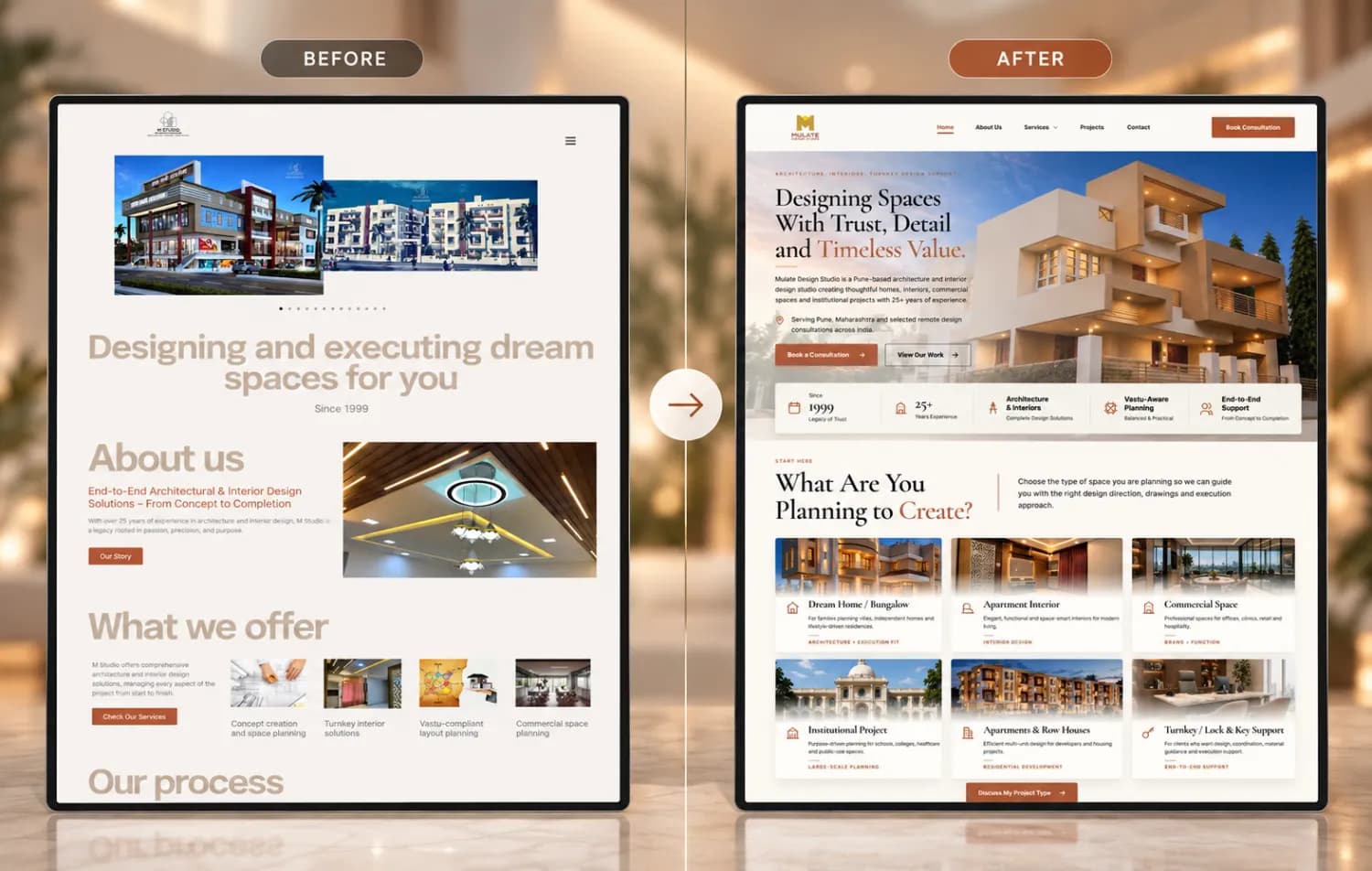
Architecture & interiors
M Studio
A practice with twenty five years of work behind it, shown through a carousel that opened on two thumbnails. Rebuilt so the projects lead and the process is legible.
See it before and afterWho delivers it
Who you will actually work with
The people who scope this work are the people who do it. 6 department heads and two directors, one team.
 Mohammed Imran MFounder & Director
 Rohit NagarHead of Creative Design
Questions
UI UX design agency questions, answered
The things people ask about ui/ux design before they buy it.
What is the difference between UI and UX?
UI is what a person sees and touches: the screens, the controls, the type and the spacing. UX is whether they got what they came for. You can have excellent UI and poor UX, and it is the most common combination we are called about.
What do UI UX design services include?
Research with real users, the flows before the screens, interface design covering every state, a clickable prototype, a component system your engineers build from, and a handover with specifications rather than pictures.
How do we choose between UI UX companies?
Ask to see their research, not their portfolio. Any UI UX design company can show you attractive screens. Far fewer can show you a recording of somebody failing to use a product and what they changed because of it.
Do we need a UI UX agency or a design system?
A system is the output, not the alternative. If you already have one and it is being ignored, the problem is usually that it was handed over as files rather than built with the engineers who have to use it.
Is this different from basic website design?
Yes. Basic website design arranges content that does not change. Product design has to handle state: what the screen shows when there is no data, too much data, a failed request or a half finished task. That is most of the work and none of the portfolio.
What does a UI UX studio actually hand over?
Design files, a component library with states and rules, the prototype, the research recordings and a written specification. If a UI UX website project ends with a set of images and nothing else, the engineers will invent the missing half.
Do you do website UI design as well as product design?
Yes. Website UI design follows the same method: research first, the path through the pages agreed before any screen is drawn, and every state designed. The difference is that a website mostly arranges content, while a product also has to handle accounts, data and tasks people leave half finished.
Can you guarantee more people will finish signing up?
No. Design removes the reasons people give up, but your pricing, your product and your market also decide whether they stay. What we promise is research with real users, flows tested before they are built, every state designed, and a handover your engineers can build from without guessing.
Often bought together
Related services
Custom websitesA site written from scratch for your business, not bent out of a theme.Read moreLanding pagesSingle-purpose pages built for a campaign, tested against a real alternative, and shipped fast enough to matter while the budget is still running.Read moreDashboards & portalsMost web application development agencies start from a feature list.Read moreEvery serviceAll twenty-eight, in one index, with what each one starts at.See them all
Insights
The thinking behind the work, in the open.
We write up the problems we had to solve for a client: how answer engines change what a page has to say, and why a redesign that ignores search can cost a year of ranking. Working notes, not filler.
7 published
All writing