
Real estate & hospitality
Real estate website design built for enquiries.
Tech Conversion provides real estate website design, local search and advertising for developers, agents, hotels and serviced apartments in India, the UAE and the USA, starting from how buyers and guests search by locality, so a property can be browsed and enquired about on a phone and every project page carries the registration details the law requires.
People decide about a property or a stay visually and fast. The site's job is to get them from the image to the enquiry before the moment passes.
- Who signs
- A buyer or guest deciding emotionally, then justifying the decision with detail.
- How long it takes
- Minutes for a booking, months for a property, with heavy comparison in both.
- What starts it
- A life change, an investment window, a travel date, or an advertisement.
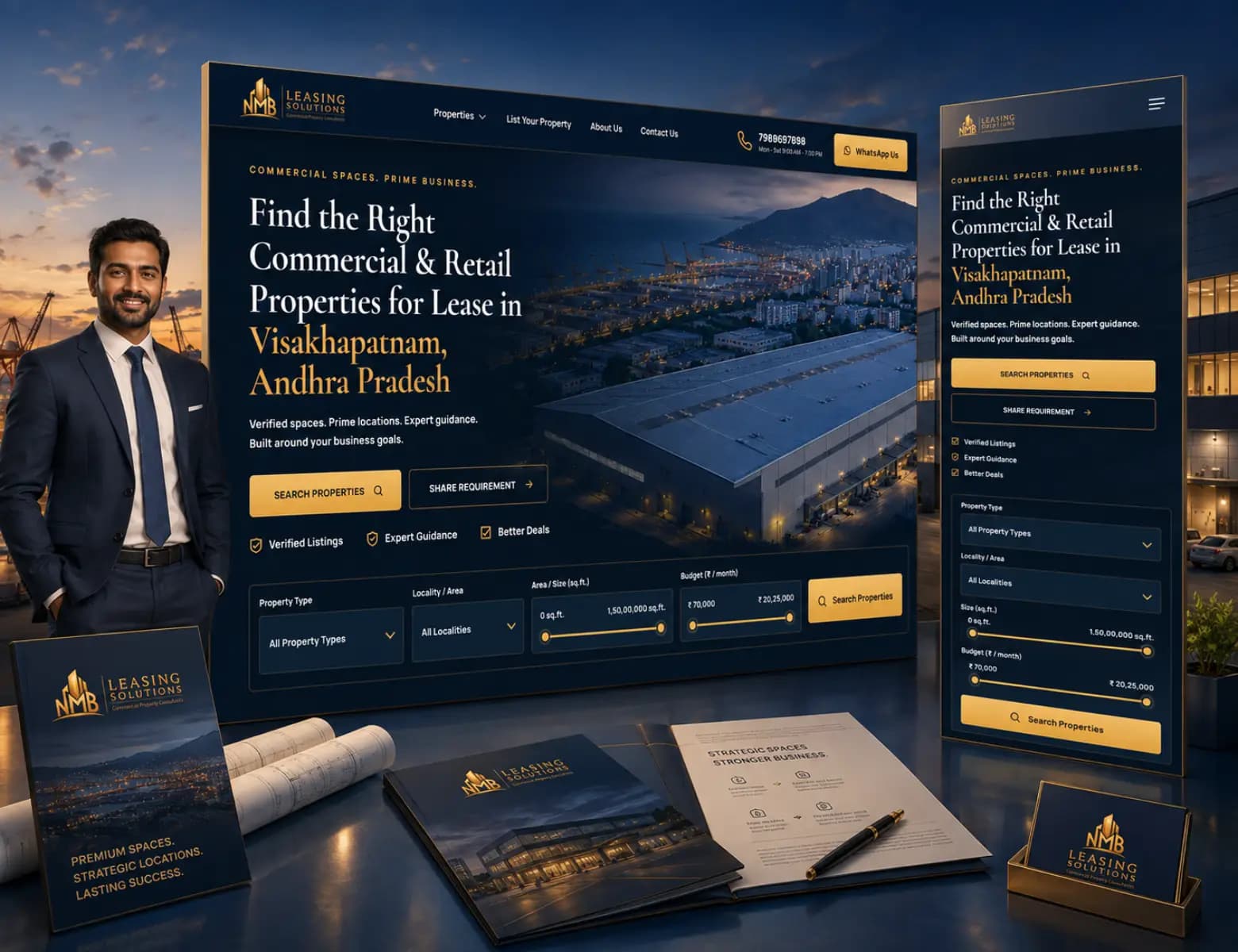
Already built in this sector
Real estate & hospitality, for these businesses
The redesign made our accommodations easier to explore and improved the overall booking experience across mobile devices.
From this sector
The work we can show you
Live sites, not mockups. Where a written case exists it is linked; where we hold a before and after, that is linked instead.
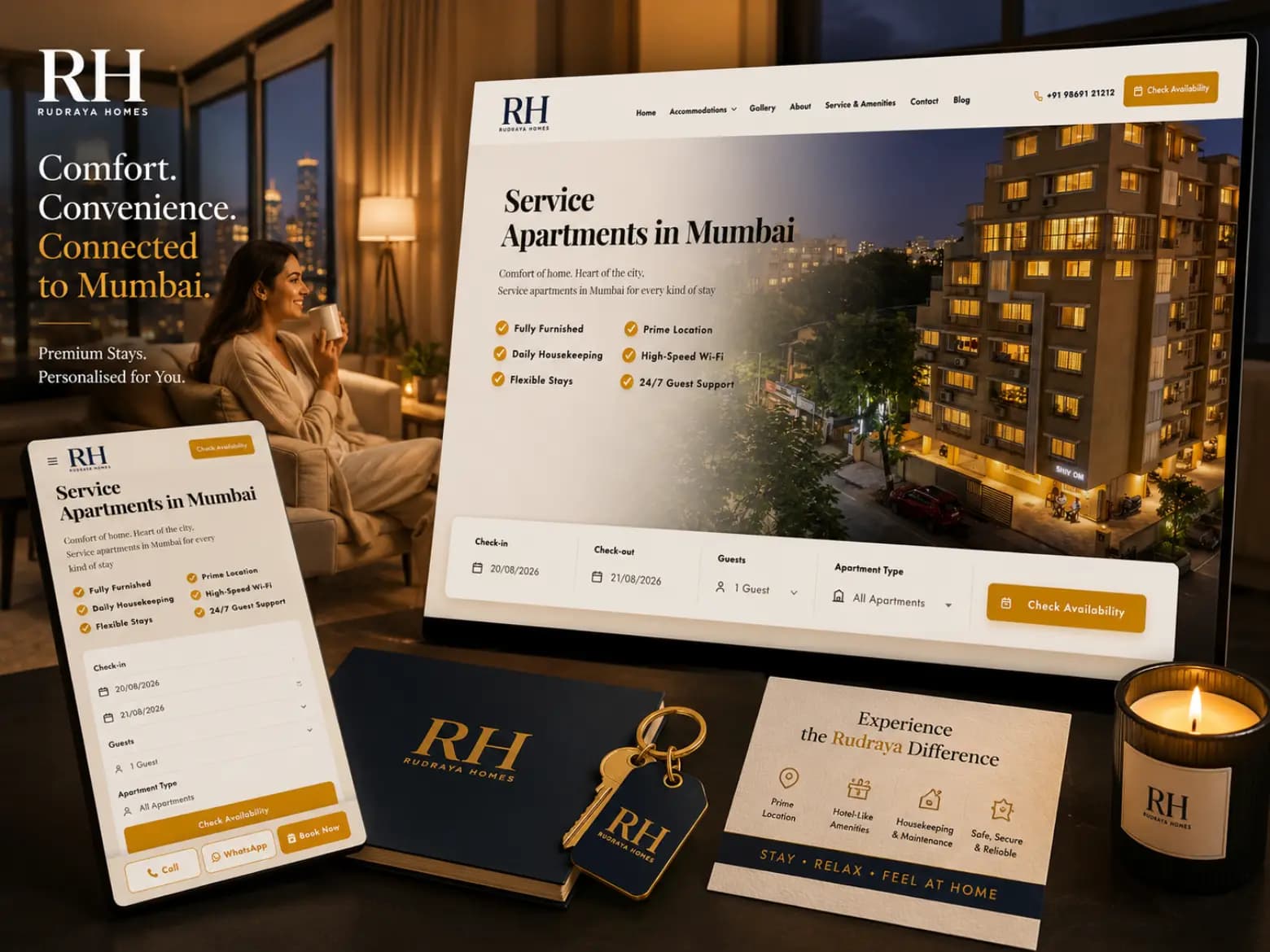
Case study · Serviced apartmentsRudraya HomesRooms you can actually browse on a phone.Read the case
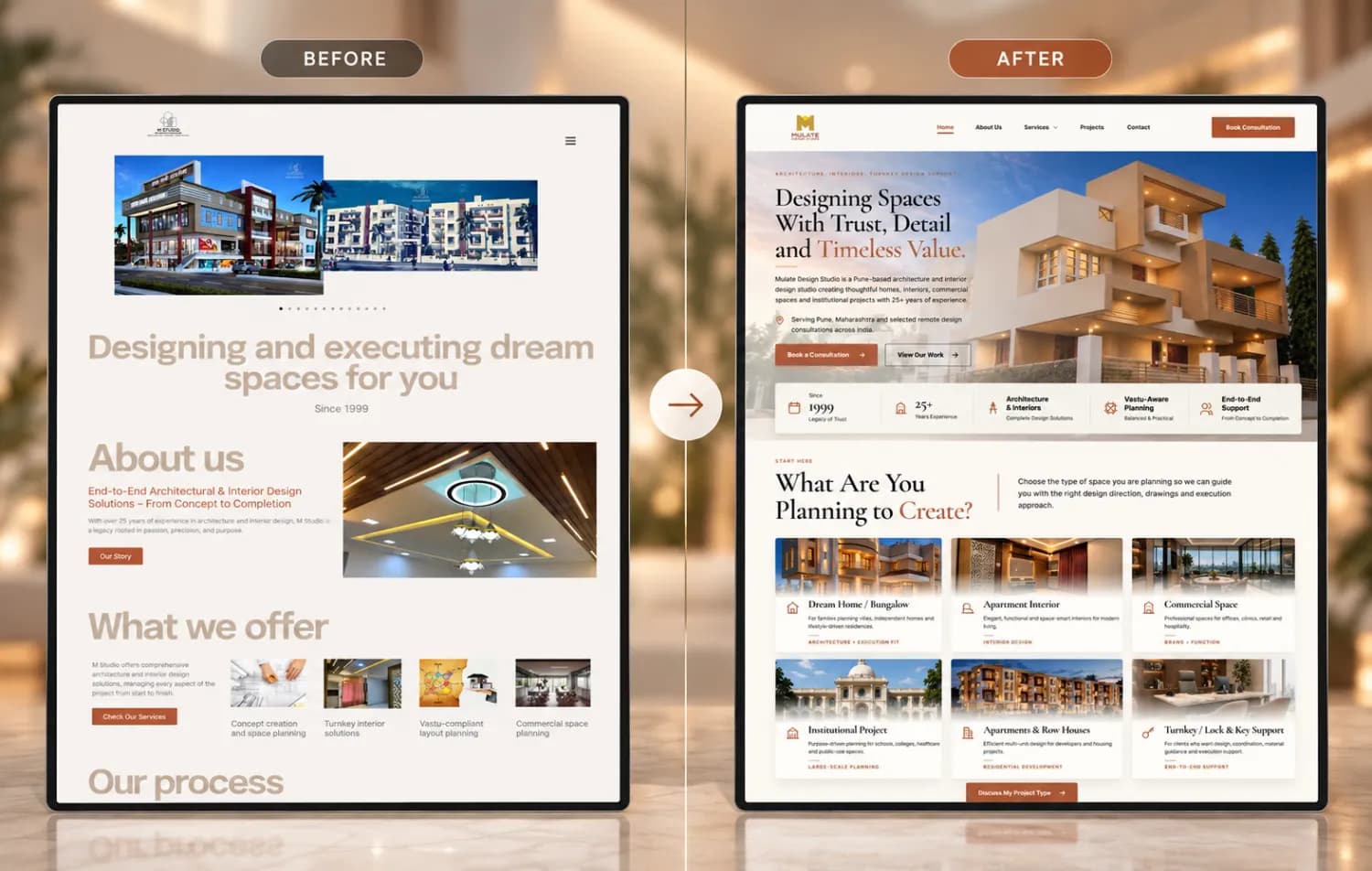
Before and after · Architecture & interiorsM StudioA practice with twenty five years of work behind it, shown through a carousel that opened on two thumbnails. Rebuilt so the projects lead and the process is legible.Compare them
Risks and exposures
What can go wrong here
Where a website or a campaign in this sector creates a liability rather than an enquiry.
Advertising a project before, or beyond, its registration
A landing page or an advertisement without the registration number, or carrying particulars that differ from what is filed, is the exposure the authority acts on most directly and the one screenshot evidence makes hardest to argue about.
Renders presented as photographs
An unlabelled visualisation, a staged flat implying it is the unit on sale, or a view from a floor that does not exist yet. Labelling costs a caption and removes a consumer complaint later.
Rates and inclusions that differ at the counter
A tariff, an inclusive rate or a cancellation rule on the site that the property does not honour arrives back as a consumer complaint and a public review, and the review outlasts the rate.
Inventory left live after it has gone
Sold units and closed rate plans still on the page produce enquiries that end in disappointment, and a sales team that has learned to distrust the website stops using it.
What we do about it
How a real estate web design agency should work
The plays that are specific to real estate & hospitality, rather than the ones every site gets.
- 01
Study the locality and the competition first
We look at what buyers and guests search for in your area, which projects or properties they compare you with, and how those sites handle price and location. The pages are planned from that.
- 02
Make images fast
Modern formats, right sizes, proper lazy loading. Quality without the weight penalty.
- 03
Answer the location question properly
Maps, real distances and honest neighbourhood context, which is what the buyer is actually assessing.
- 04
Be as clear on price as you can be
A range with what moves it, rather than nothing. Silence loses more buyers than a number does.
- 05
One enquiry, always reachable
A persistent, simple way to ask about this specific property or stay, on every scroll position.
- 06
Property and project pages that rank
Individual pages with real local content, because search demand here is intensely location-led.
- 07
Local search and reviews
Map pack presence and review flow, which decide a large share of hospitality bookings.
- 01Study the locality and the competition first. We look at what buyers and guests search for in your area, which projects or properties they compare you with, and how those sites handle price and location. The pages are planned from that.
- 02Make images fast. Modern formats, right sizes, proper lazy loading. Quality without the weight penalty.
- 03Answer the location question properly. Maps, real distances and honest neighbourhood context, which is what the buyer is actually assessing.
- 04Be as clear on price as you can be. A range with what moves it, rather than nothing. Silence loses more buyers than a number does.
- 05One enquiry, always reachable. A persistent, simple way to ask about this specific property or stay, on every scroll position.
- 06Property and project pages that rank. Individual pages with real local content, because search demand here is intensely location-led.
- 07Local search and reviews. Map pack presence and review flow, which decide a large share of hospitality bookings.
What this sector usually needs
What a real estate website development company should cover
Linked rather than re-explained. Each one has its own page with what it includes, what it costs and how it runs.
Custom websitesA site written from scratch for your business, not bent out of a theme.Landing pagesSingle-purpose pages built for a campaign, tested against a real alternative, and shipped fast enough to matter while the budget is still running.Google Business ProfileWinning the map pack and the near me searches.Meta AdsA Facebook ads agency for people who are not searching for you yet.
The rules you work under
Regulatory framework
The regulators, statutes and standards this sector is subject to, and what each one changes about a website or a campaign. Linked to the source, so you can check us. This is not legal advice.
- Real Estate (Regulation and Development) Act, 2016↗
A registered project cannot be advertised without its registration number, and the advertisement has to agree with the registered particulars, including carpet area, approved plans and the declared completion date. This applies to the website, the landing page and the ad creative equally.
- Tamil Nadu Real Estate Regulatory Authority↗
The authority a Chennai project registers with and where its particulars are published. A registration number shown on the site should be verifiable against that listing, and the project details on the page should match what has been filed there.
- FSSAI licence display↗
Where a hotel, restaurant or serviced property serves food, the licence is displayed and the number is expected on the premises and on the surfaces where food is ordered, including a menu page or an in-room ordering screen on the website.
- State Shops and Establishments registration↗
A hospitality property or an agency office registers under the state Act, which covers the hours it may operate. Opening hours, staffed reception times and contact details published on the site and on map listings should match how the place actually runs.
- Consumer Protection Act, 2019 and the CCPA guidelines on misleading advertisements↗
Renders, starting-from prices, amenity lists and inclusive tariffs are advertisements. A visualisation has to be labelled as an artist's impression, an amenity has to be one the buyer or guest actually gets, and an inclusive rate has to include what it says it does.
- Digital Personal Data Protection Act, 2023↗
Site visit requests, booking forms and guest records are personal data, and hospitality records can include identity documents. The purpose has to be stated where it is collected, and consent to marketing has to be separate from the booking or the enquiry.
What we measure
Measured, not asserted
We do not publish industry benchmarks we cannot source. What we can say is exactly what gets measured for a client in this sector, and how.
Enquiries and booking requests by property and locality
Attributed to the page and campaign that produced them and grouped by project or property, so demand for one location can be told apart from general interest in the brand.
Direct bookings against portal bookings
The share arriving through the property's own path, taken from the property management system rather than from the website alone, because the point of the direct channel is the commission it avoids paying.
Local visibility by area term
Rankings and map visibility tracked for locality and property-type searches, per location, read alongside how consistent the listing details are across the profiles that carry them.
Gallery behaviour on a phone
How far a visitor gets through the images and plans on a mobile device, and which asset stalls the sequence, since the gallery is where the shortlisting decision is actually made.
Questions
Real estate website questions, answered
What real estate & hospitality buyers ask before they commission work.
What should a real estate website include?
Fast galleries, because showing the property is the one thing the site must do well. Then real location context with maps and distances, a price or a credible range, floor plans and specifications, and an enquiry path you can reach from anywhere on the page. Hotel website design adds live availability and a clear booking promise to the same list.
Should property prices be shown on the website?
Show a price or a credible range wherever you can. Price on request removes you from the shortlist of buyers who are filtering, and most buyers filter before they enquire.
What has to appear on a real estate project's website in India?
The RERA registration number, shown with the authority it is registered under, and particulars that agree with what has been filed: carpet area, approved plans and the declared completion date. The same applies to landing pages, portal listings and advertising creative, not only to the main site. Visualisations should be labelled as artist's impressions, and any amenity shown should be one that is actually part of the sanctioned project.
What does a real estate web development company build that a designer does not?
The parts that hold data: listings, availability, enquiry routing and an editing screen that non-technical staff can use. Knowing the registration rules is also part of the job for a real estate website development company. India's RERA requires the registration number on every advertisement, and a project website counts as one.
What makes real estate website design work?
Getting someone to enquire rather than just browse. Real estate design that aims for time on site is aiming at the wrong thing. Most visits happen on a phone, so the gallery and the floor plans have to load quickly on mobile data and be readable on a small screen.
What should a real estate landing page do?
One property or one development, one action. Real estate agent websites usually push everything to a single enquiry form, which loses the person who wanted this building rather than your agency.
How are hotel and resort websites different?
The competition is a booking portal, not another hotel. A resort website has to give a guest who found the property on a portal a reason to book direct: the rate, the room detail, the cancellation terms and a booking path that works on a phone. Keep the portal listings, because that is where people search, and measure the direct share from the property management system rather than from the website's own reports.
Do you build hotel management websites and listing sites?
Yes, and they are application work rather than brochure work. A hotel management website and real estate listing websites both hold live data that somebody has to maintain, so the editing experience decides whether the site stays accurate after month three.
Do we need a real estate PPC agency as well?
Only if the numbers support it. Paid search works when people are actively searching for your kind of property and one sale or booking is worth far more than the clicks it takes to win it. We check the search volume and your margins before recommending it, and any real estate digital marketing agency in India should also check every advertisement against the project's RERA registration before it runs.
Can you guarantee enquiries or bookings?
No. Enquiries depend on the property, the price, the location and the market, and on changes at Google and the portals that nobody controls. What we promise is the work: research into how buyers and guests search, fast pages with the registration details right, tracking of every enquiry and booking, and steady improvement from what that tracking shows.
Adjacent sectors
Not quite your sector?
Insights
The thinking behind the work, in the open.
We write up the problems we had to solve for a client: how answer engines change what a page has to say, and why a redesign that ignores search can cost a year of ranking. Working notes, not filler.
7 published
All writing