
Education & training
Education site design that answers the real question.
Tech Conversion does education site design, search and advertising for schools, colleges, coaching institutes and training providers in India, the UAE and the USA, starting from what students and parents search for, so course pages answer fees, duration and outcomes and every enquiry reaches a counsellor quickly.
Every prospective student is asking the same three things before anything else: what will it cost, how long will it take, and what happens afterwards.
- Who signs
- The student and the person paying, who are usually not the same person and do not want the same information.
- How long it takes
- Weeks to a year, tied to intake dates and results seasons.
- What starts it
- Exam results, an intake deadline, a career change, or a parent's decision.
Already built in this sector
Education & training, for these businesses
The team brought structure to a complex project and made every stage easy to understand. The final result exceeded our expectations.
What this sector is under
What an education website has to handle
The pressures that shape how a buyer here reads a website, before anything about the website itself.
Two people decide, and only one is the student
The student draws up the shortlist and a parent or sponsor funds it. The page has to carry both the ambition and the reassurance without either reader feeling it was written for somebody else in the room.
The calendar is fixed and unforgiving
Intakes, entrance results, term dates and visa deadlines set the demand. A site or a campaign that is ready a fortnight late has missed a cycle rather than a fortnight, and the next one is a year away.
Recognition is the first thing checked
Affiliation, approval and accreditation are verified against the regulator's own published lists, often while the parent is still on the page. Anything stated vaguely is read as an absence rather than as modesty.
Enquiries arrive in a rush and cool fast
A prospective student contacts several institutions in the same evening and joins whichever answers properly first. The speed and quality of the reply decides more of this sector's conversion than the page that produced the enquiry.
What goes wrong on the sites
- Fees hidden. The first question, unanswered. Most visitors leave rather than fill a form to find out.
- Outcomes stated as adjectives. Excellent placements, world-class faculty. Nothing a family can weigh against another institution.
- One page for student and parent. The student wants the experience, the parent wants the return. Both get a compromise.
- Enquiry forms that ask too much. Fifteen fields at the top of a decision that is months away. The form becomes the barrier.
Who we work with
Inside education & training
The roles and company types inside the sector, and the situations that bring them to a firm like this one.
Who we work with
- Founders and directors of training institutes, coaching centres and skills programmes
- Overseas education and admissions consultancies
- Schools and colleges whose admissions team owns the enquiry flow
- Corporate training and certification providers selling to employers as well as to learners
What brings them to us
- A new programme or intake the current site cannot carry
- An admissions season where enquiries outran the team answering them
- An advertising account rejected over education claims in the copy
- Expansion to a second campus or an overseas market
- A printed prospectus that has become the only accurate document
What this sector usually needs
School website design and what goes with it
Linked rather than re-explained. Each one has its own page with what it includes, what it costs and how it runs.
Custom websitesA site written from scratch for your business, not bent out of a theme.Landing pagesSingle-purpose pages built for a campaign, tested against a real alternative, and shipped fast enough to matter while the budget is still running.SEOTechnical, on-page and content SEO run as one programme.Meta AdsA Facebook ads agency for people who are not searching for you yet.
What we do about it
Education site design that starts with the questions
The plays that are specific to education & training, rather than the ones every site gets.
- 01
Start with what families search for
Before any design we look at what students and parents search for around your courses, which institutes they compare you with and what those sites leave unanswered. Comparison, eligibility and fee questions usually carry the real demand, long before anyone searches your name.
- 02
Publish fees, or explain them
A range with what changes it beats a form. Where fees genuinely vary, say what drives the variation.
- 03
State outcomes concretely
Duration, structure, certification and what graduates actually go on to do, in specifics you can stand behind.
- 04
Separate the two readers
A path for the student and a path for whoever is paying, each honest about what it is.
- 05
Course pages that stand alone
Every course its own page, complete enough to be the only page someone reads before enquiring.
- 06
Enquire in three fields
Capture the minimum, qualify in the follow-up. Admissions teams convert conversations, not form fields.
- 01Start with what families search for. Before any design we look at what students and parents search for around your courses, which institutes they compare you with and what those sites leave unanswered. Comparison, eligibility and fee questions usually carry the real demand, long before anyone searches your name.
- 02Publish fees, or explain them. A range with what changes it beats a form. Where fees genuinely vary, say what drives the variation.
- 03State outcomes concretely. Duration, structure, certification and what graduates actually go on to do, in specifics you can stand behind.
- 04Separate the two readers. A path for the student and a path for whoever is paying, each honest about what it is.
- 05Course pages that stand alone. Every course its own page, complete enough to be the only page someone reads before enquiring.
- 06Enquire in three fields. Capture the minimum, qualify in the follow-up. Admissions teams convert conversations, not form fields.
How the work differs here
Same services, different work
What changes about the build and the marketing when the client is in this sector, compared with the version every site gets.
Recognition written exactly as it is held
Approval, affiliation and accreditation stated with the awarding body and the programmes covered, because a parent verifies it against the regulator's list within minutes and a shorthand version reads as evasion.
One page per course, built to be arrived at cold
Fees, duration, eligibility, intake dates, format, who teaches and what follows, complete on the course page, since most visitors reach it from a search for the course rather than through the homepage.
Written to the student and the parent at once
The experience and the outcome in the body of the page, the cost, the safety, the support and the contact answered on the same screen, so neither reader has to go looking for the half addressed to them.
Enquiry handling built as part of the site
Forms routed into the counsellor's queue with the source recorded and the response time visible, because in this sector the reply is where the conversion happens and an unrouted form is a lost intake.
From this sector
The work we can show you
Live sites, not mockups. Where a written case exists it is linked; where we hold a before and after, that is linked instead.
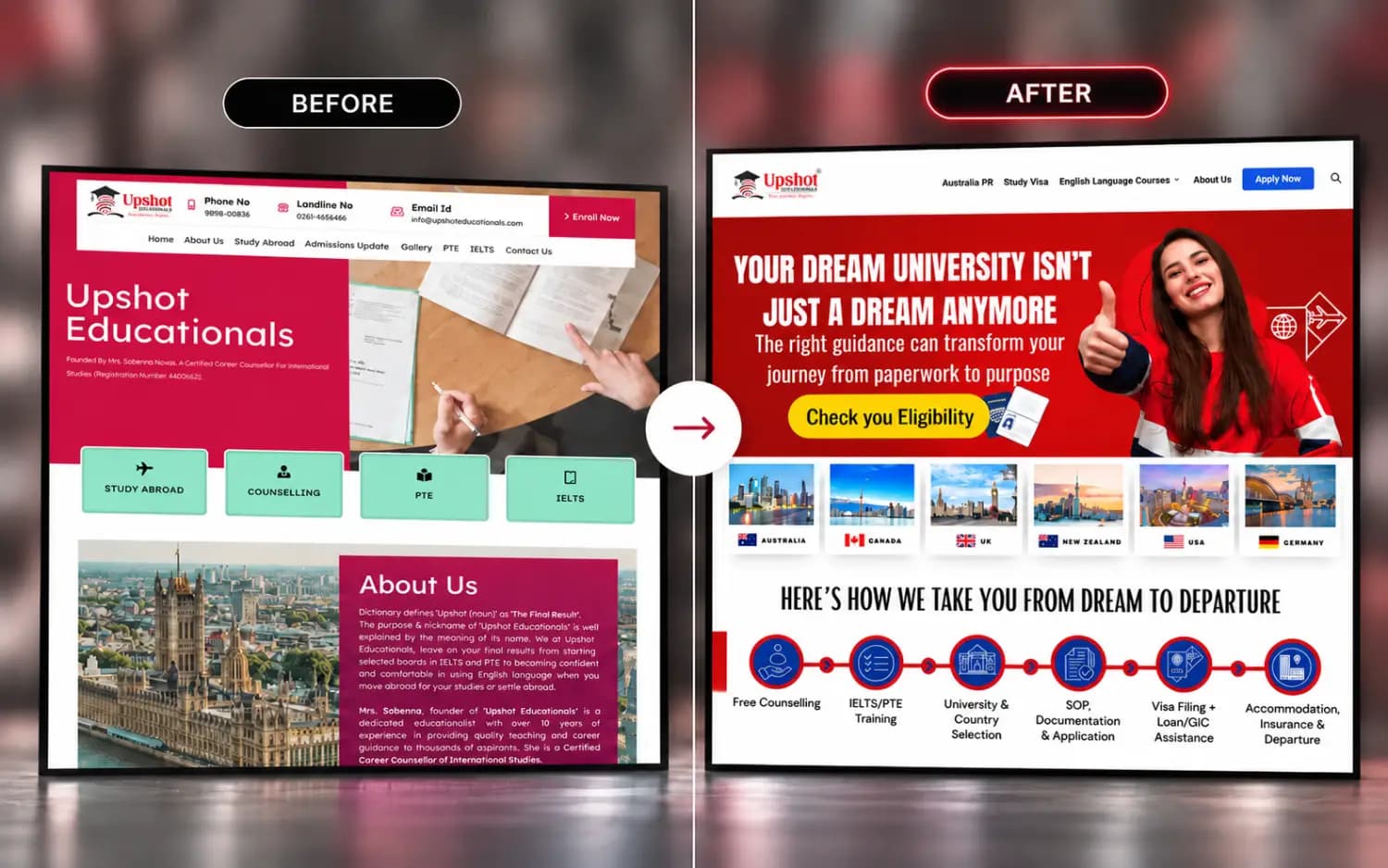
Before and after · Overseas educationUpshot EducationalsA study-abroad brand rebuilt around the one question every student actually arrives with, with the enquiry path pulled to the surface.Compare them
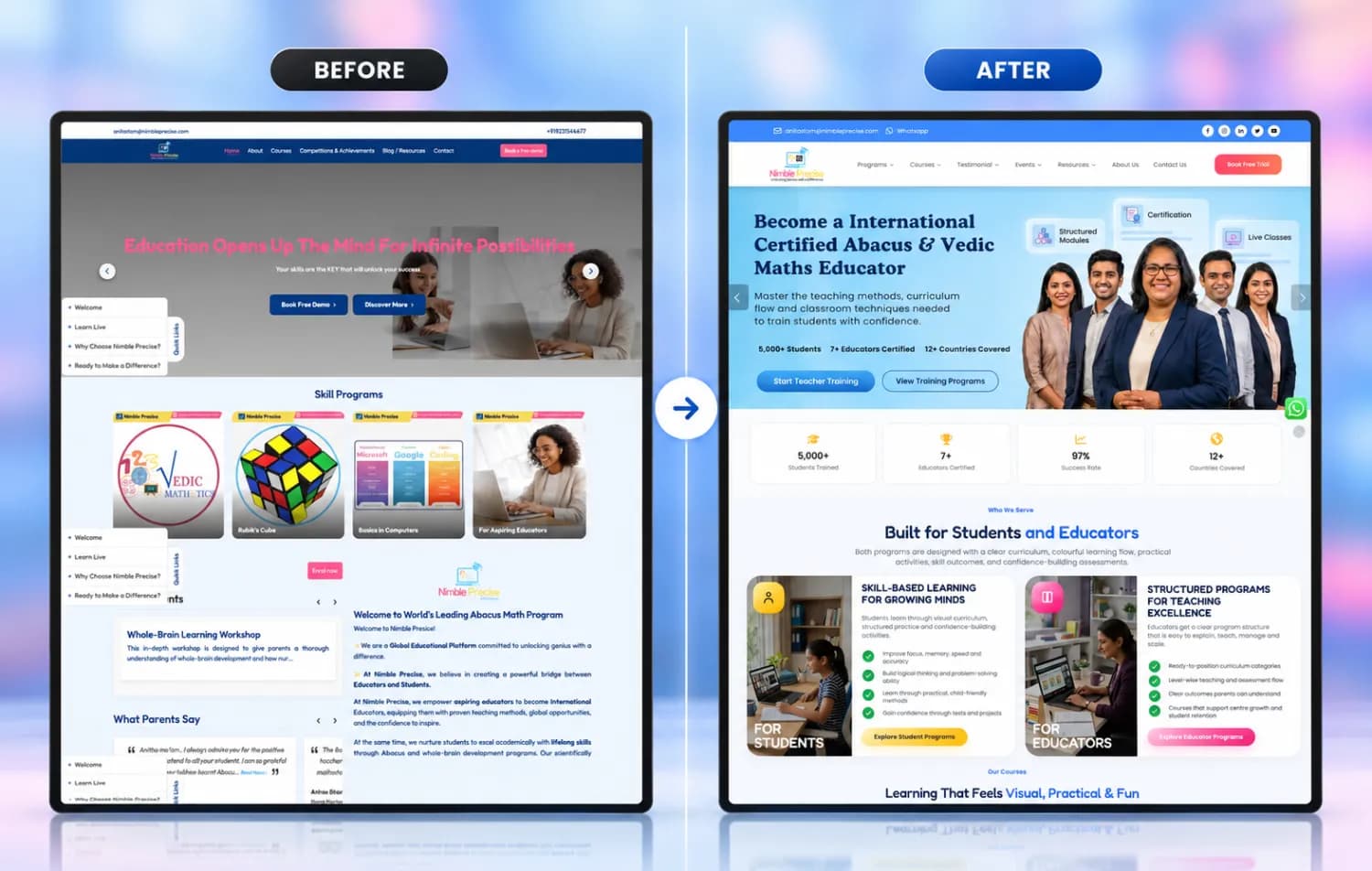
Before and after · Education & trainingNimble PreciseAn abacus and maths programme whose old site buried the courses under stacked panels and floating link boxes. Rebuilt so a parent can see the programmes, the outcomes and the way in without hunting.Compare them
Risks and exposures
What can go wrong here
Where a website or a campaign in this sector creates a liability rather than an enquiry.
Recognition described loosely
An affiliation written in shorthand, a partner's approval implied as the institute's own, or a course listed under an approval that covers a different programme. It is verified in minutes and the correction, when it comes, is public.
Placement and outcome guarantees
Assured placement wording is treated as an advertisement under the consumer protection framework and the ASCI education guidelines, and the substantiation has to exist before publication. Careers support is a description. A guarantee is a promise the institute cannot keep.
Minors' data collected casually
A chat widget, a long enquiry form or a remarketing pixel on pages aimed at school students brings in data that needs verifiable parental consent, usually without anyone having decided to collect it.
Student photographs and quotes used past their consent
A picture kept on the site years after the student left, or a testimonial moved onto a programme they never took. Consent was given for one use and the site quietly extended it.
What we measure
Measured, not asserted
We do not publish industry benchmarks we cannot source. What we can say is exactly what gets measured for a client in this sector, and how.
Enquiries by programme and by intake
Counted per course and against the position in the admissions cycle rather than by calendar month, so this intake is compared with the same intake last year instead of with an unrelated quiet period.
Time from enquiry to first real contact
Measured from the form submission to the moment a counsellor actually speaks to the applicant, using the team's own system, because that interval decides more of the outcome than anything on the page.
Course page visibility for course and eligibility searches
Tracked per programme, including the fee, syllabus, eligibility and comparison questions people search around a course, rather than for the institution's name which it will rank for regardless.
Applications started against applications completed
The application or registration form treated as its own funnel and measured step by step on a phone, since a form built for a desktop is where a committed applicant is most often lost.
Questions
School website questions, answered
What education & training buyers ask before they commission work.
Should an education website publish course fees?
Yes, wherever possible. Fees are the first thing students and parents look for, and hiding them behind a form loses more good enquiries than it captures. Where fees vary, publish a range and say what moves it. Then say what the course actually leads to, in specifics, because 'excellent placements' is not an answer.
What can an institute say about recognition and approval?
Exactly what it holds, named with the body that granted it and the programmes it covers. The UGC publishes lists of institutions that are not recognised and has acted over websites and prospectuses claiming otherwise, and a parent checks the claim against that list in minutes. Where a technical programme requires AICTE approval, name the approval and the programme it applies to rather than implying it covers the whole institute.
Can a training institute advertise placement rates or guarantees?
The guarantee is what causes the trouble. Placement and outcome claims in education advertising fall under the consumer protection framework and the ASCI guidelines for educational institutions, so substantiation and the period it covers have to be held before publication. Describing the careers support, the employers who recruit and the process honestly does the same persuading and survives the complaint that a guarantee invites.
How should a course page be structured?
As a page someone can arrive at knowing nothing about the institute, because most visitors reach it straight from a search. It needs the fees, duration, eligibility, intake dates, format, who teaches it, how it is assessed and what happens afterwards, all without a download, plus an easy way to ask a question.
What does good education site design actually solve?
Two audiences with one homepage. Education website design has to serve the person choosing and the person already enrolled, and most institution sites are built entirely for the second.
What should a school website include?
Admissions, fees, term dates, transport, contact and a way to see the place. Anyone working out how to create a school website should start from that list rather than from a template. School website design fails most often by burying admissions under news, which is the one section a prospective parent never came for.
What is different about design for school sites compared with a company?
The decision is emotional and the evidence is practical. A parent wants to feel something and then check something, in that order, which is why photography and hard information have to sit close together rather than in separate sections.
Do you handle school management website design?
Yes, scoped as application work. School management website design, such as the portal parents and staff log into, is closer to software than to a website, so website design for school management system work runs through our portals service. Smaller pieces are different: a school library website design usually works better as a well-structured section than as its own site, and a school website homepage design on its own rarely fixes what is wrong underneath.
What should a coaching institute website show?
Batches, fees, timings, faculty and results you can back up. Students and parents compare several institutes in one evening, so a coaching institute website that hides the fee or the batch timing loses to the one that shows it. Results claims need evidence held before they go on the page, and a guaranteed selection or rank is exactly the kind of claim the consumer protection rules treat as misleading.
Can you guarantee more admissions?
No. Admissions depend on your courses, fees, reputation and how quickly your team replies, and on competitors and search changes nobody controls. What we promise is the work: research into what students and parents search for, course pages built to answer it, tracking of every enquiry by programme, and steady improvement from what that tracking shows.
Adjacent sectors
Not quite your sector?
Insights
The thinking behind the work, in the open.
We write up the problems we had to solve for a client: how answer engines change what a page has to say, and why a redesign that ignores search can cost a year of ranking. Working notes, not filler.
7 published
All writing