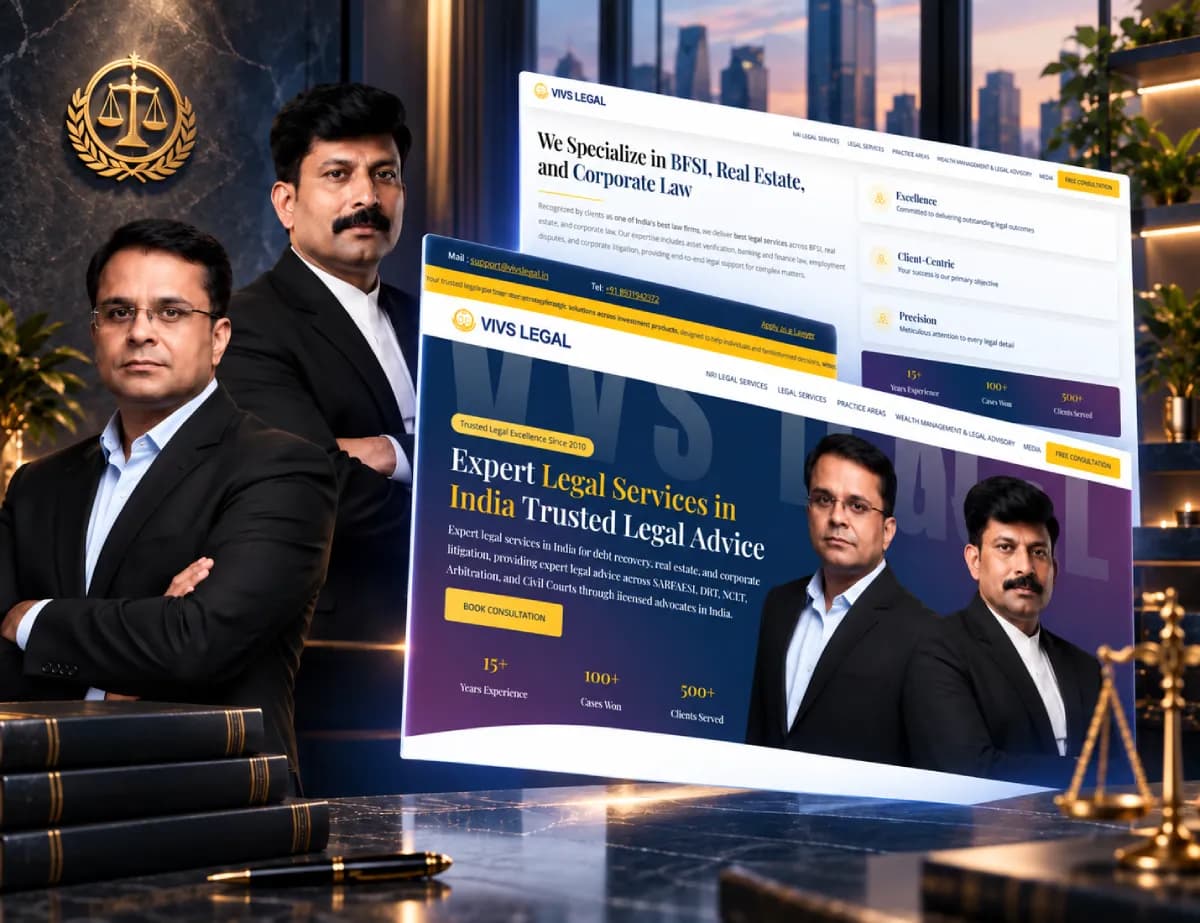

Legal & professional services
Law firm web design agency that shows competence before the first call.
Tech Conversion is a law firm web design agency working with lawyers, chartered accountants and consultancies in India, the UAE and the USA, building sites inside each profession's advertising rules so a client can find the practice, understand what it handles and make contact, without the page soliciting work the rules forbid.
Clients hire a firm they trust with something that frightens them. The site has to establish competence quickly and make the first contact feel low risk.
- Who signs
- An individual or a business owner facing something consequential, often for the first time.
- How long it takes
- Days to weeks, with two or three firms contacted in parallel.
- What starts it
- A dispute, a deadline, a transaction, or a regulatory demand.

Already built in this sector
Legal & professional services, for these businesses
The rules you work under
Regulatory framework
The regulators, statutes and standards this sector is subject to, and what each one changes about a website or a campaign. Linked to the source, so you can check us. This is not legal advice.
- Bar Council of India Rules, Part VI, Chapter II, Rule 36↗
An advocate may not advertise or solicit work, directly or indirectly. Since the 2008 amendment the rule permits a website carrying only the advocate's name, address, telephone number, email, enrolment number, professional and academic qualifications and areas of practice, with a declaration that the particulars are true. That decides the whole site: no success claims, no client lists, no testimonials, no comparative language.
- ICAI Code of Ethics and its website guidelines↗
Chartered accountants are restricted from soliciting work, and the guidelines set what a firm's website may contain and how it may be presented. A CA firm's site is built to those limits rather than to ordinary marketing practice, and the limits differ from the ones an advocate works under.
- Digital Personal Data Protection Act, 2023↗
Enquiry forms here collect details of a dispute or a matter. Collect only what is needed to arrange a call, state the purpose, and keep matter detail out of analytics events and chat transcripts, where it creates both a data problem and a conflict-check problem.
- Consumer Protection Act, 2019 and the CCPA guidelines on misleading advertisements↗
Reaches the professional services that are not under a professional body's advertising ban, such as consulting, compliance and advisory work. Claims about outcomes, savings or turnaround are advertisements and need substantiation held before they are published.
- ASCI Code↗
Applies where a professional services firm does advertise. It governs comparative claims, superlatives and disclaimers, and it expects the evidence for a claim to exist at the time the claim is made rather than to be assembled once it is questioned.
- WCAG 2.2 AA↗
Clients read these pages under stress, and some read them with a screen reader or a magnified display. Contrast, focus order, labelled forms and readable documents decide whether somebody can make contact without needing to ask another person for help first.
What this sector is under
The problems specific to legal & professional services
The pressures that shape how a buyer here reads a website, before anything about the website itself.
The rules decide what the page may contain
An advocate's website exists by permission and within defined limits, so everything persuasive has to happen through structure, precision and being findable, rather than through the claims and calls to action other sectors treat as ordinary.
The client arrives worried and badly informed
Somebody holding a notice or facing a dispute usually does not know which kind of lawyer they need. The site's real work is helping them place their own problem, before it does anything else.
Referral is still the main channel, and it is verified
A name passed on is searched before it is called. What that search returns, the practice's own site or a half-finished directory profile, decides whether the referral survives the evening.
Confidentiality limits the evidence
Matters cannot be written up the way projects are elsewhere, so credibility has to be carried by qualification, area of practice and the accuracy of the explanations the site publishes.
What goes wrong on the sites
- Practice areas as a list. One page listing twelve specialisms ranks for none of them and reassures nobody.
- Written in the language of the profession. Technically correct, and no use to someone who does not yet know the right words for their own problem.
- Nothing about cost or process. The two things every nervous client wants to know before calling, and the two things most firms omit.
- Contact as a formal barrier. A long form and an office address, when the person wants to know if their situation is even the right fit.
What we do about it
How we approach law firm web design
The plays that are specific to legal & professional services, rather than the ones every site gets.
- 01
Read the rules and the market first
Before any design we confirm what the professional rules allow, look at how clients describe their situation when they search in your area, and study the firms they will compare you with.
- 02
A real page per practice area
Each with its own depth and its own search demand, rather than one page trying to cover everything.
- 03
Write in the client's words
People search their situation, not your specialism. The content meets them where their vocabulary is.
- 04
Explain how you charge
Where the professional rules allow it, the model at minimum: fixed fee, hourly or retainer, and what a first conversation costs.
- 05
Show the people
Named professionals with qualifications and experience, because clients hire a person, not a firm name.
- 06
Make the first step small
A short, clearly bounded first conversation is easier to accept than an open-ended contact form.
- 01Read the rules and the market first. Before any design we confirm what the professional rules allow, look at how clients describe their situation when they search in your area, and study the firms they will compare you with.
- 02A real page per practice area. Each with its own depth and its own search demand, rather than one page trying to cover everything.
- 03Write in the client's words. People search their situation, not your specialism. The content meets them where their vocabulary is.
- 04Explain how you charge. Where the professional rules allow it, the model at minimum: fixed fee, hourly or retainer, and what a first conversation costs.
- 05Show the people. Named professionals with qualifications and experience, because clients hire a person, not a firm name.
- 06Make the first step small. A short, clearly bounded first conversation is easier to accept than an open-ended contact form.
Risks and exposures
Where a lawyer website goes wrong
Where a website or a campaign in this sector creates a liability rather than an enquiry.
A page that reads as solicitation
Success language, client lists, testimonials, comparative claims and marketing calls to action borrowed from another sector take an advocate's site outside what Rule 36 permits, and the rule binds the advocate rather than whoever wrote the page.
Matter detail arriving where it should not
A long enquiry form, a chat transcript or a field captured in analytics can carry privileged detail and can create a conflict problem before anybody in the practice has read a word of it.
Outcome claims from the unregulated side of the firm
An advisory or consulting arm making savings or turnaround claims still sits under the consumer protection framework, and the substantiation has to exist before publication rather than after the complaint.
Commentary published without clear authorship
Articles with no named author, or material reused from elsewhere, undermine precisely the credibility the page exists to build, and in this sector that is the only thing the page is allowed to build.
Who delivers it
Who you will work with
The people who scope work in this sector are the people who do it.
 Mohammed Imran MFounder & Director
From this sector
The work we can show you
Live sites, not mockups. Where a written case exists it is linked; where we hold a before and after, that is linked instead.
What this sector usually needs
Law firm website development and the services around it
Linked rather than re-explained. Each one has its own page with what it includes, what it costs and how it runs.
Corporate websitesA company site that reads as credible to a customer, a candidate and an investor at the same time, without turning into a brochure nobody finishes.SEOTechnical, on-page and content SEO run as one programme.Google Business ProfileWinning the map pack and the near me searches.AI-search visibilityPeople increasingly ask ChatGPT, Gemini and AI Overviews instead of scrolling ten blue links.
What we measure
Measured, not asserted
We do not publish industry benchmarks we cannot source. What we can say is exactly what gets measured for a client in this sector, and how.
Contacts made, by area of practice
Calls and form submissions attributed to the practice area page that produced them, so a page for the work the firm wants more of can be judged on its own instead of inside a firm-wide total.
Whether the firm's own site is what a referral finds
Visibility for the practice's own name checked against the directories, listings and aggregator profiles that otherwise occupy those results, because the referred client searches the name before anything else.
Visibility for situation language
Rankings for the plain words people use to describe a matter before they know its legal name, tracked per area of practice rather than for the terms lawyers use among themselves.
What the site still fails to answer
Which pages were read before a contact, and which questions still arrive on the first call, reviewed with the practice so the page can absorb them and the call can start further along.
Questions
Law firm website questions, answered
What legal & professional services buyers ask before they commission work.
What should a law firm website include?
A separate page for each practice area, a profile of each lawyer with their qualifications, a plain explanation of how a matter proceeds and a simple way to make first contact. One page listing twelve specialisms ranks for none of them. For an advocate in India, every element also has to sit within what Bar Council of India Rule 36 permits, so the list is shorter and the wording matters more.
Should a professional services firm publish its fees?
Where the professional rules allow it, publish the charging model even if exact figures are impossible. Saying whether work is fixed fee, hourly or retained, and what an initial consultation costs, removes the main hesitation before someone makes contact. An advocate in India is limited to the particulars Rule 36 permits, so this applies to consultants and advisers rather than to an advocate's own site.
Can a law firm in India advertise its services online?
An advocate cannot advertise or solicit work, directly or indirectly. Rule 36 of the Bar Council of India Rules, Part VI, Chapter II, as amended in 2008, permits a website carrying the advocate's name, address, telephone number, email, enrolment number, professional and academic qualifications and areas of practice, with a declaration that the particulars are true. That is the permitted content, and it rules out success claims, client lists, testimonials and comparison with other practices.
What can a law firm's website do beyond listing the permitted details?
It can be clear, and clarity is not advertising. Within what the rule permits, a practice can set out its areas of practice in language a non-lawyer understands, explain how the practice is organised and who handles what, and make contact straightforward on a phone. What it cannot do is present itself as better than another practice, publish testimonials or imply outcomes, which is where most borrowed website templates go wrong.
Do the same rules apply to chartered accountants and consultants?
They apply differently, and the difference matters. Chartered accountants work under the ICAI Code of Ethics and its website guidelines, which restrict solicitation and set out what a firm's site may contain. Consultants and advisers outside a professional body's advertising rules can market normally, but claims about outcomes, savings or turnaround are advertisements under the consumer protection framework and need substantiation held in advance.
What does law firm web design have to achieve?
Credibility that survives a check. A law firm website is opened by somebody who has already been referred to you, so the job is confirming the recommendation rather than making the case from nothing.
What should law firm website development include?
Named people with real credentials, practice areas as their own pages, and enquiry handling that respects confidentiality. Law firm website design fails most often on the first of those, because a lawyer website with unnamed profiles reads worse than an empty page.
What do the best law firm website design companies do differently?
They ask who will review the practice area pages before they show a single layout. The best law firm website design is restrained and specific: fewer claims, more evidence, and practice areas checked by someone who practises them, because the detail that makes a page rank is the same detail that makes it accurate.
What do law firm website design services usually leave out?
The people. Law firm website designers are often given headshots and a job title and nothing else, and the resulting profiles say less than a directory listing would. Lawyer website design lives or dies on whether the partners will give an hour each.
Can you guarantee new clients or a top ranking?
No. Enquiries depend on your reputation, your areas of practice, your competitors and changes at Google that nobody controls, and for advocates the rules limit what any site may say. What we promise is the work: a site that stays within those rules, practice pages clear enough to be found, tracking of every contact by practice area, and steady improvement from what that tracking shows.
Insights
The thinking behind the work, in the open.
We write up the problems we had to solve for a client: how answer engines change what a page has to say, and why a redesign that ignores search can cost a year of ranking. Working notes, not filler.
7 published
All writing