

Technology & IT services
IT company website design that explains the product without a demo call.
Tech Conversion provides IT company website design, SEO and marketing for technology, managed services and cybersecurity firms in India, the UAE and the USA, built on research into how their technical buyers search, so the site explains a complex offer clearly enough to survive an engineer's read and a finance lead's sign-off.
Technical buyers judge a vendor's site the way they judge a vendor. If the page cannot survive a sceptical read, the meeting never gets booked.
- Who signs
- A technical lead or IT director, usually with a finance sign-off behind them.
- How long it takes
- Weeks to months, with a shortlist stage where three vendor sites are compared side by side.
- What starts it
- A contract renewal, an incident, or an internal project that exposed a gap.

Already built in this sector
Technology & IT services, for these businesses
The website and SEO direction have helped us present our services more clearly and reach a more relevant audience.
What this sector is under
What IT and cybersecurity marketing is up against
The pressures that shape how a buyer here reads a website, before anything about the website itself.
The buyer already knows the field
Whoever evaluates an IT vendor has read the same page from nine competitors this quarter and can tell when an acronym is doing the work an outcome should. Copy that would pass in another sector is read here as evasive.
Two readers, one page
A technical lead scrutinises the depth and a commercial sponsor scans for the outcome. A page written for one of them loses the other, and the deal needs both.
Referrals get verified
Most IT services work arrives by recommendation, and the first thing the recommended party does is search the name. The site is the reference check.
The site is a work sample
A technology company with a slow, broken or dated site has answered the buyer's question about quality before a call is booked. Nothing on the page recovers from that.
Security buyers are paid to doubt
Cybersecurity digital marketing sells to people whose job is to find the gap in a claim. Fear-led copy, breach figures with no source and a row of badges all count against the firm. The page has to persuade with specifics a security lead can check.
What goes wrong on the sites
- Everything is a capability, nothing is an outcome. Service lists that read as an inventory. The buyer has to work out for themselves which problem you solve.
- Jargon used as proof. Acronyms stacked to sound credible, which reads as evasive to someone who actually knows the field.
- No evidence a technical reader accepts. Logos without context. A technical buyer wants scope, stack and outcome, not a wall of brands.
- The site itself is slow. A technology firm with a six-second page load has already answered a question the buyer was going to ask.
The rules you work under
Regulatory framework
The regulators, statutes and standards this sector is subject to, and what each one changes about a website or a campaign. Linked to the source, so you can check us. This is not legal advice.
- Digital Personal Data Protection Act, 2023↗
Most IT services firms process client data as a processor. The privacy policy and any enquiry form have to say what is collected and why, and consent to marketing has to be a recorded, separate choice.
- CERT-In Directions of 28 April 2022↗
Service providers, intermediaries and data centres in India carry incident reporting and log retention obligations. A site that promises response times or uptime has to promise ones the firm can actually meet under these.
- Information Technology Act, 2000 and the SPDI Rules, 2011↗
The reasonable security practices rules that predate the DPDP Act and still apply. They shape what a security page can claim and what a client contract references.
- ISO/IEC 27001↗
Not a legal requirement, but the security standard enterprise and public sector procurement asks about first. The site should state plainly whether the firm holds it, is working towards it, or aligns to it, and never blur the three.
- SOC 2↗
For firms selling to US clients, the attestation buyers ask for before an MSA is signed. As with ISO, the page states the actual status. A logo without a report behind it is found out in due diligence.
- GDPR↗
Applies the moment an EU customer's data is processed. Relevant to what the site collects from EU visitors and to how the firm describes its role to EU clients.
How the work differs here
Same services, different work
What changes about the build and the marketing when the client is in this sector, compared with the version every site gets.
Evidence is structured, not decorative
Case content is written as context, scope, stack and outcome, because that is the shape a technical buyer accepts. A wall of logos is not evidence to this reader.
The build is part of the pitch
Performance, accessibility and clean markup are held to a stricter budget here, because for a technology firm the site is a work sample the buyer inspects.
Cybersecurity website design starts from proof
A security firm's site is inspected like a product. We design around what a buyer can verify: the scope of each service, certifications exactly as they stand, and plain answers to the questions in a security questionnaire. Padlock imagery proves nothing.
MSPs win on the buyer's questions
Choosing a managed service provider is slow and careful, and buyers research the decision long before they search for a name. A plain guide to that decision, including when a buyer should look elsewhere, is often what earns the place on the shortlist.
What we do about it
How we build for this sector
The plays that are specific to technology & IT services, rather than the ones every site gets.
- 01
Research before anything is designed
We talk to the people who sell, study the competitors a buyer will compare you with and run an SEO technical audit. Services, case studies and product pages are then planned around what buyers actually search for.
- 02
Lead with the problem, not the stack
Each service page opens on the situation the buyer is in, then earns the right to describe how you solve it.
- 03
Depth available, not compulsory
A clear surface for the sponsor, with real technical detail one click down for the person who will scrutinise it.
- 04
Evidence with specifics
Case content structured as context, scope and result, so it survives a sceptical read.
- 05
Prove it with the build
Fast, accessible, cleanly marked up. For this sector the site is a work sample.
- 06
Search and answer engines, in the buyer's words
Buyers search symptoms and technologies, not your service names, and many now ask an AI assistant to draw up the shortlist. The content follows how they actually search, and is written so it can be quoted accurately.
- 01Research before anything is designed. We talk to the people who sell, study the competitors a buyer will compare you with and run an SEO technical audit. Services, case studies and product pages are then planned around what buyers actually search for.
- 02Lead with the problem, not the stack. Each service page opens on the situation the buyer is in, then earns the right to describe how you solve it.
- 03Depth available, not compulsory. A clear surface for the sponsor, with real technical detail one click down for the person who will scrutinise it.
- 04Evidence with specifics. Case content structured as context, scope and result, so it survives a sceptical read.
- 05Prove it with the build. Fast, accessible, cleanly marked up. For this sector the site is a work sample.
- 06Search and answer engines, in the buyer's words. Buyers search symptoms and technologies, not your service names, and many now ask an AI assistant to draw up the shortlist. The content follows how they actually search, and is written so it can be quoted accurately.
What we measure
Measured, not asserted
We do not publish industry benchmarks we cannot source. What we can say is exactly what gets measured for a client in this sector, and how.
Qualified enquiries, not enquiries
Counted only once a first call has confirmed the fit. In this sector a form fill from a student or a job seeker is noise, and reporting it as a lead flatters everyone and helps nobody.
Search visibility for problem terms
Rankings and impressions for the symptoms and technologies buyers actually type, tracked per service page, alongside the vendor-name terms.
Answer-engine presence
Whether the firm appears when an assistant is asked to shortlist providers for the problems it solves. Checked by query, monthly.
Page speed on a mid-range phone
Core Web Vitals held in the good band on the devices a buyer actually uses on the way to a meeting, and reported alongside the traffic figures.
Risks and exposures
Where a technology company website loses the deal
Where a website or a campaign in this sector creates a liability rather than an enquiry.
Overclaiming on security
A badge, a certification or a compliance word used loosely on a marketing page becomes a due-diligence finding later. Every claim on the site has to match a document the firm can produce.
Jargon that reads as evasion
The technical buyer treats an unexplained acronym as a sign there is nothing behind it. The site has to be able to say what it does in plain words as well as precise ones.
A slow site from a firm that sells speed
The single most damaging inconsistency in this sector. It is also the easiest to measure, which is why the buyer does.
Case studies that name what they should not
Client confidentiality is normal here. A case that discloses a client's stack or a vulnerability to win a new one is a liability, not proof.
A marketing stack that fails its own audit
For a security firm, an outdated plugin, an exposed admin login or an unchecked tracking script on its own website is the first thing a prospect's security team will find. It ends the conversation before sales knows it started.
From this sector
The work we can show you
Live sites, not mockups. Where a written case exists it is linked; where we hold a before and after, that is linked instead.
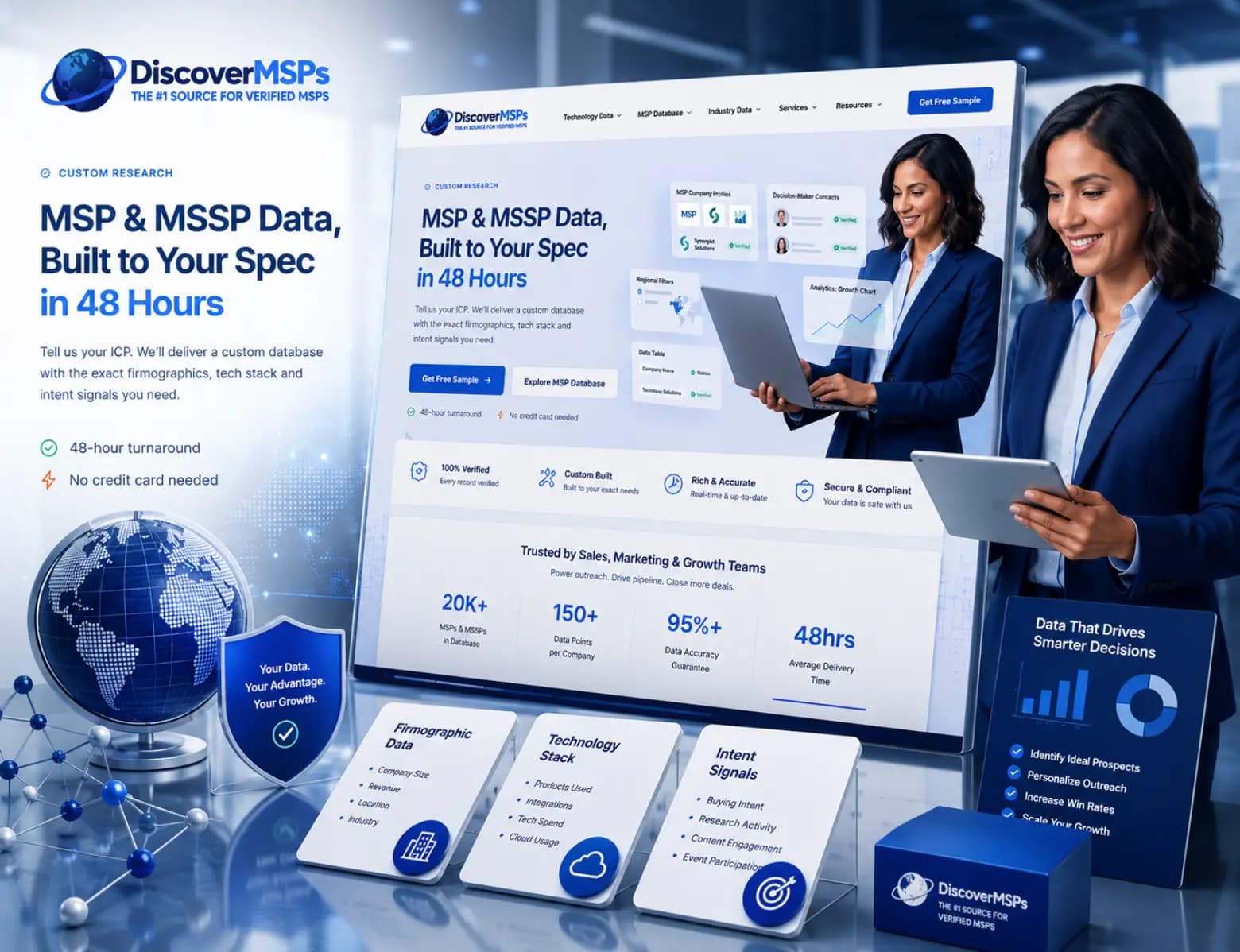
Case study · B2B data platformDiscoverMSPsA data platform that sells its own subscriptions.Read the case
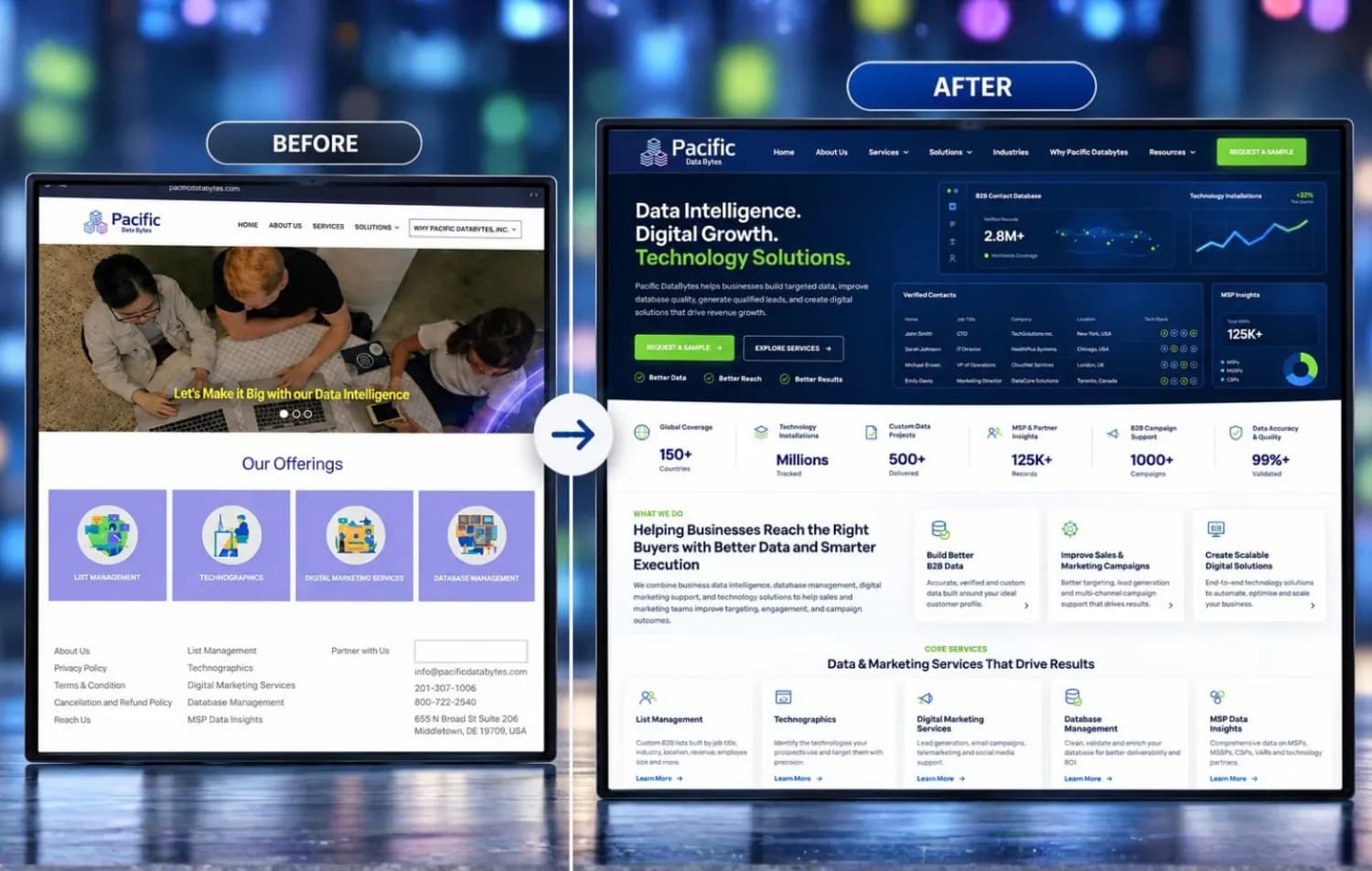
Before and after · B2B dataPacific Data BytesA data intelligence firm with four coloured tiles and very little else. Rebuilt around what the offerings actually are and who each one is for.Compare them
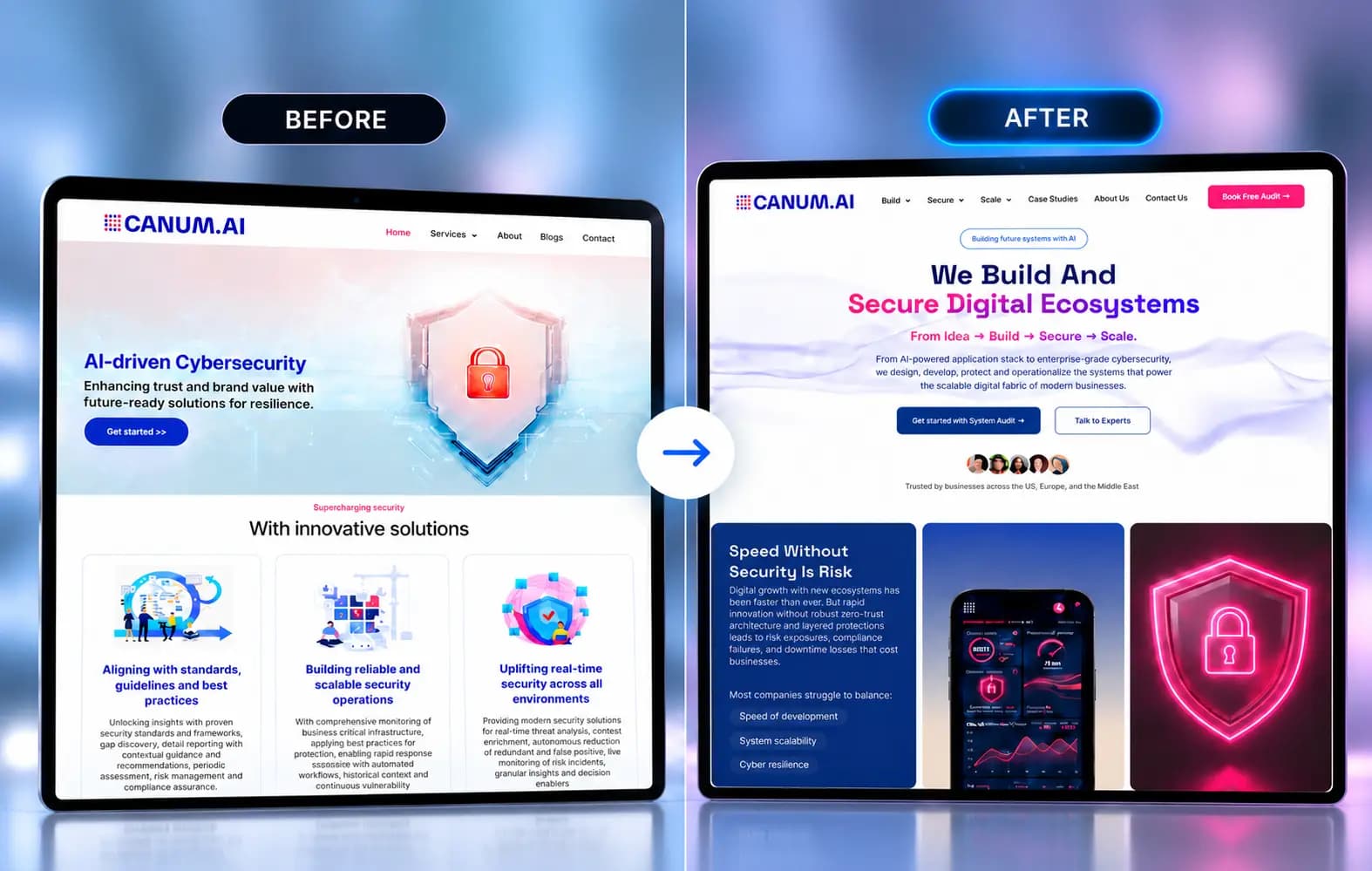
Before and after · Artificial intelligenceCanum AIA technical product given a clear first screen, so the value lands before anyone is asked to book a demo.Compare them
Who we work with
Inside technology and IT services
The roles and company types inside the sector, and the situations that bring them to a firm like this one.
Who we work with
- Founders and managing directors of IT services firms and managed service providers
- Heads of sales and marketing at software and data companies
- Technical leads who have been handed the website as a side project
- Cybersecurity firms and managed security providers selling to IT and risk teams
- Firms from a handful of people to a few hundred, selling to businesses rather than consumers
What brings them to us
- A contract renewal where the client is quietly comparing alternatives
- A security incident, theirs or a competitor's, that has changed what buyers ask
- A new service line the current site has no page for
- A referral that did not convert, and the suspicion the site is why
- Entering a market abroad where nobody has heard of the firm
Who delivers it
Who you will work with
The people who scope work in this sector are the people who do it.
 Mohammed Imran MFounder & Director
What this sector usually needs
IT website services that apply here
Linked rather than re-explained. Each one has its own page with what it includes, what it costs and how it runs.
Custom websitesA site written from scratch for your business, not bent out of a theme.SEOTechnical, on-page and content SEO run as one programme.AI-search visibilityPeople increasingly ask ChatGPT, Gemini and AI Overviews instead of scrolling ten blue links.Dashboards & portalsMost web application development agencies start from a feature list.
Questions
IT company website design questions, answered
What technology & IT services buyers ask before they commission work.
What makes IT company website design different?
Your buyer is technical and reads the site as a sample of your work. Web design for IT company sites is judged on load time, structure and whether the claims survive scrutiny, so lead with the problems you solve, give each service its own page and put evidence next to each claim. There are also two readers: design technology website pages so the first screen serves the person approving and the depth below serves the person evaluating.
Do IT companies need SEO if they sell through referrals?
Usually, because referrals get checked. A prospect who is given your name will search it, and what they find decides whether the referral turns into a meeting. Search also reaches the buyers your referral network never will.
Should an IT company publish its security certifications on its website?
Yes, and exactly as they stand. State whether a certification is held, in progress or aligned to, with the scope and the date, because a procurement team will ask for the certificate and a logo without one becomes a due-diligence finding. If the firm holds nothing yet, a plain security page describing actual practices is more credible to a technical buyer than a borrowed badge.
What should a managed service provider's website say about response times?
Only what the contract will say. Response and resolution times on a marketing page are read by buyers as commitments, and under the CERT-In directions Indian service providers already carry reporting obligations they cannot promise around. Publish the service levels you actually sell, by tier, and let the page send the buyer to a call for anything the tiers do not cover.
What content works best for a managed service provider?
Honest help with the decision itself. Buyers want to know how to choose a provider long before they want a name, so a plain guide covering costs, contracts and when to walk away earns trust a services page cannot. Sector versions work even better: a school's IT lead searching how to choose a managed services provider for schools wants answers on student data, budgets and term-time support. Tools help too, such as an IT cost calculator or a security readiness checklist.
Do we need a specialist cybersecurity marketing agency?
Not necessarily. You need a team that will learn your product properly, let your engineers correct the copy and refuse to publish a claim you cannot document. Sector experience helps, but that discipline matters more. What works is the same as in any good B2B digital marketing. Cybersecurity buyers simply punish the shortcuts faster.
Does SEO for cybersecurity firms work differently?
The mechanics are the same as any other SEO. Cybersecurity is the extreme case of something every technology firm faces: buyers search threats, standards and integrations rather than vendor names, and the reader often knows more than the writer. Cybersecurity SEO is won by answering those questions accurately, with an engineer checking each page before it goes live.
Is cyber security marketing different in India and the USA?
Yes, in what buyers check and in how they spell it. Buyers in India ask about CERT-In obligations and where data is held, while buyers in the USA usually ask for a SOC 2 report before they sign. Most American buyers write cybersecurity as one word, and many Indian buyers write cyber security as two. So marketing for cyber security firms that sell in both countries usually needs separate pages, each written the way that market searches.
Who does the best IT company website design?
The firm that will ask what your product actually does before showing you layouts. Ask any agency to explain your product back to you in one sentence. Most cannot, and it shows in the site they would have built.
Can you guarantee rankings or enquiries?
No, and be careful of anyone who does. Rankings, enquiries and mentions in AI answers depend on your market, your competitors and changes at Google that nobody controls. What we do promise is the work: research into how your buyers search, a fast and sound build, tracking you can check, and steady improvement from real data.
Adjacent sectors
Not quite your sector?
Insights
The thinking behind the work, in the open.
We write up the problems we had to solve for a client: how answer engines change what a page has to say, and why a redesign that ignores search can cost a year of ranking. Working notes, not filler.
7 published
All writing