
Ecommerce Web Design
Ecommerce Web Design Built Around How Your Customers Buy.
New stores, redesigns and development: planned from the catalogue to the confirmation email, and tested on the phone your customers actually use.
Swagy Soul, designed and developed by Tech Conversion. Real mobile pages, captured October 2026.
Stores we have built
 Swagy Soul
 Paudhaawala
 Life With Oxygen
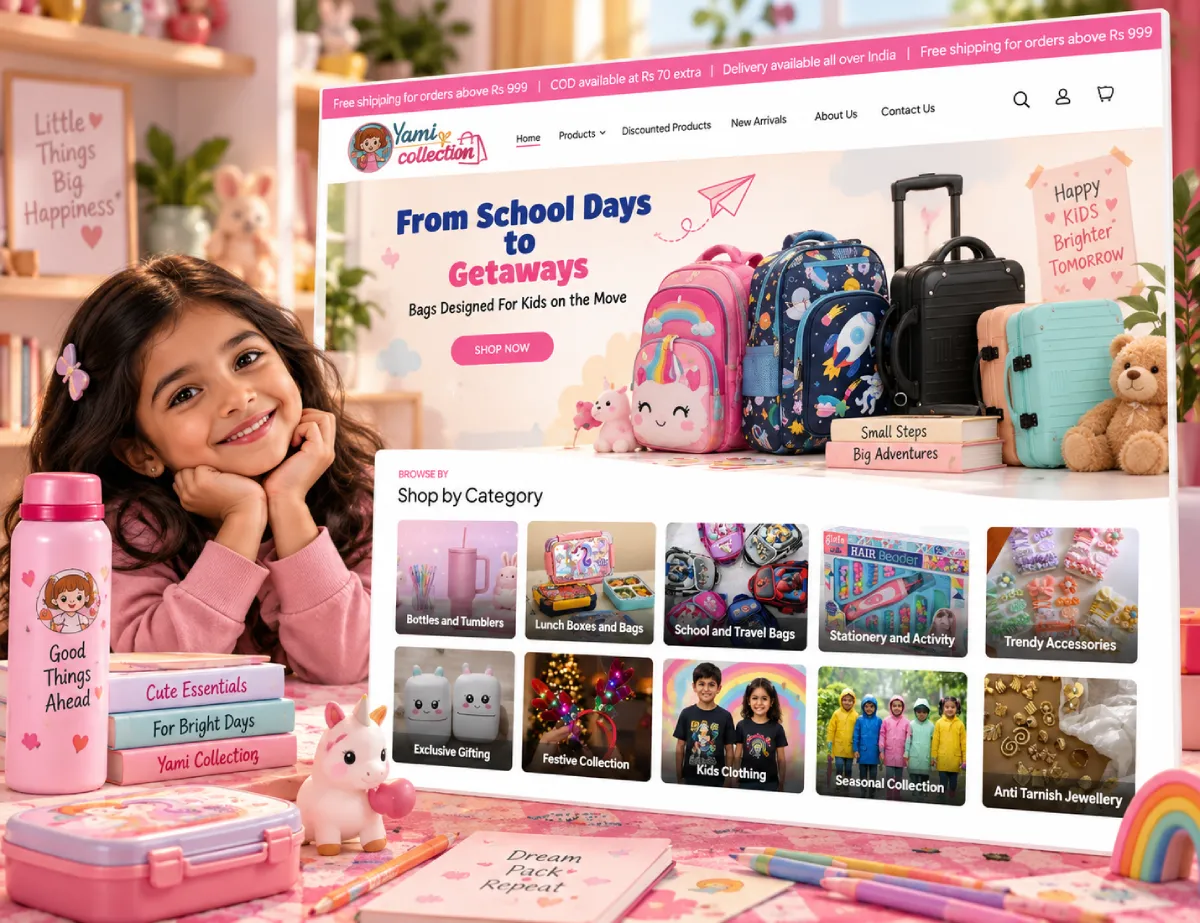 Yami Collection
 Luxora Tiles
 Jutti Choo
 Wholesale Hub


What does your store need?
Three starting points. One service.
Whether you are opening, fixing or moving a store, the work starts from where you are.
Launch
A store that is ready to take orders on day one.
- Platform chosen for your catalogue and team
- Categories, attributes and variants planned before design
- Payments, shipping and taxes configured and tested
- Policies and legal disclosures built into the templates
Paudhaawala opened its own store while also selling on Amazon, Flipkart and Meesho.
Selected ecommerce projects
Past the homepage. Into the buying path.
Three live stores, shown where it matters: finding a product, deciding on it, paying for it.
Streetwear · Consumer brand
Swagy Soul
Business requirementShoppers arriving on a phone had to work to reach the product, and the details that settle a purchase were spread across the journey.
Store implementationCategories by style and price, filters and sorting, colour and size variants, a stock message, a delivery check by PIN code, size and fit guides, and guest checkout.
Verified outcomeNo sales or traffic figures are published for this project. The before and after of the store is shown above.
Plants and planters
Paudhaawala
Business requirementA plant shop selling by room and by need, such as bedroom, office, low maintenance or Vastu, as well as by plant.
Store implementationTwelve shopping categories with tags, pot colour and size options, delivery check by PIN code, a damaged-plant replacement promise on the page, cash on delivery and online payment.
Verified outcomeNo sales or traffic figures are published for this project.
Health and wellness
Life With Oxygen
Business requirementWellness products that had to be explained in plain language to cautious buyers, without implying outcomes.
Store implementationA focused catalogue in four categories, size options such as 15, 30 and 50 ml, customer reviews on the product page, and a delivery check before adding to cart.
Verified outcomeThe founder’s own video review. No sales figures are published.
What your ecommerce build includes
From catalogue to first order.
Ten parts of every build, in the order they happen. What is not included is listed just as clearly.
- 01DiscoveryHow you sell, fulfil and get paid today, and where the buying path leaks.
- 02Catalogue structureCategories, attributes and variants, planned before design.
- 03UX and designCategory, product, cart and checkout templates, designed for phones first.
- 04DevelopmentThe store built on the agreed platform, responsive throughout.
- 05Agreed product importYour products loaded from a spreadsheet or old store, up to the agreed count.
- 06Payments and shippingGateway, taxes, delivery zones, charges and cash on delivery if used.
- 07TestingTest orders on every payment method, on real phones.
- 08TrackingProduct view, cart, checkout and purchase events, checked against orders.
- 09LaunchGo live in a quiet window, then watch the first orders.
- 10TrainingProducts, orders, promotions and stock, for whoever runs the store.
- Product photography and copywriting
- Products beyond the agreed import count
- Extra integrations: stock, accounting, couriers
- Subscriptions, bundles or wholesale pricing
- Payment gateway and transaction fees, which you hold directly with the provider
- Platform plans, hosting and paid apps or plugins
- Stock, fulfilment and courier integrations beyond the ones named in the scope
- Advertising spend, which is a separate engagement
Choosing the right platform
Shopify, WooCommerce or custom? Let the catalogue decide.
Answer four questions. The column that fits lights up, with its limits shown beside its strengths.
| Area | Shopify | WooCommerce | Custom |
|---|---|---|---|
| Operations | Hosted for you; orders, stock and payouts in one admin | Self-hosted on WordPress; orders and stock in the WordPress admin | Built around your workflow; admin designed to fit |
| Editing | Easy product and collection editing; content pages more limited | Products and rich content in one familiar editor | Whatever is built; editing must be designed in |
| Functionality | Strong standard features; extras come from apps | Very flexible; extras come from plugins or code | Anything you can specify and pay for |
| Integrations | Large app store; deep custom work uses its APIs | Plugins plus custom code for most systems | Direct integrations, built to your systems |
| Maintenance | Platform updates handled by Shopify | WordPress, plugin and server updates are your responsibility, or ours on a plan | Ongoing developer upkeep required |
| Recurring costs | Monthly plan, paid apps, and fees per transaction depending on gateway | Hosting, paid plugins, gateway fees | Hosting, developer time, gateway fees |
| Limits to know | Checkout customisation is restricted, with more control only on higher plans | Performance depends on hosting and plugin choices | Longer to build; you own every bug fix |
Plan prices and fees change; we confirm current figures in the proposal.
Catalogue, navigation and product discovery
Shoppers find it. Fast.
A real category page we built, annotated. Then scale the tools to the size of your catalogue.
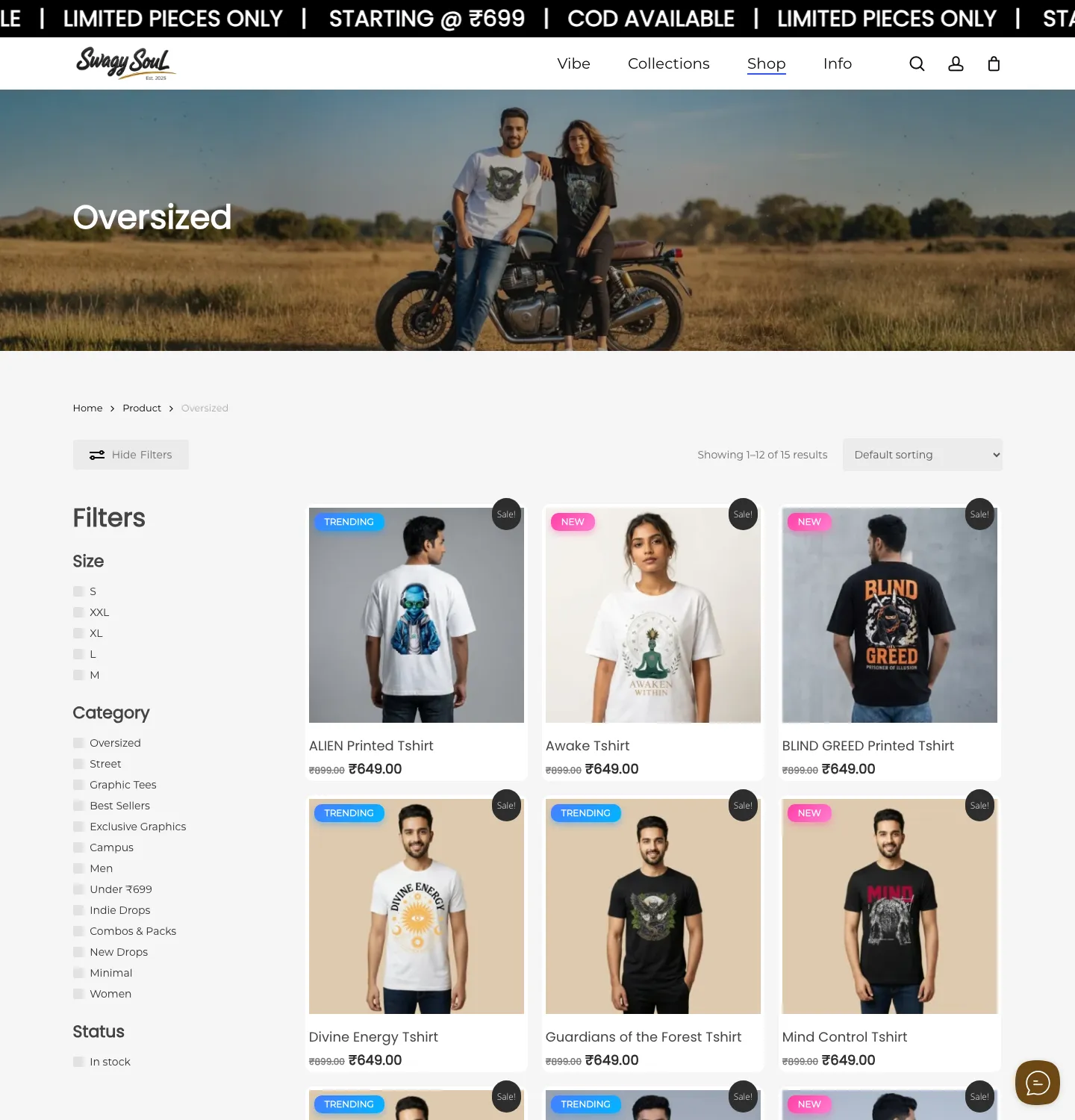
A named category with its own heading and image, which is also the page search engines index for that category.
Swagy Soul, Oversized category, desktop.
- Clear categoriesINCLUDED
- SortingINCLUDED
- Variants (size, colour)INCLUDED
- FiltersINCLUDED
- Site search with suggestionsINCLUDED
- Collections by need or occasionINCLUDED
- Search that handles typos and synonymsNOT NEEDED YET
- Faceted filters with countsNOT NEEDED YET
Filters and search start to earn their place. Collections by need, like the plant store’s rooms, help people choose.
Product pages that support decisions
Every question answered before it is asked.
A real Swagy Soul product page. Choose a decision point and the phone scrolls to it.
Different products, different questions.
- Seller details
- Total price with all charges
- Delivery timelines
- Return and refund policy
- Grievance officer
- MRP inclusive of taxes
- Net quantity
- Manufacturer or importer
Reviews are shown only where customers have genuinely left them; we never seed or write them.
Cart, checkout and payments
Paying should be the easy part.
A real cart and checkout we built, and a prototype you can click through: clear charges, real validation, a proper confirmation.
We design checkouts to remove obstacles. We do not promise a conversion rate, because that depends on product, price and traffic too.
Store operations and integrations
After “Place order”, everything still has to work.
Follow one order through the systems behind it. Each step shows the system, who owns it, and what it costs.
Step 1 of 6
Order placed
The store records the order, reserves the stock and sends the confirmation.
- Typical systems
- Your store platform
- Responsible
- Built by us; run by your team
- Third-party fees
- None beyond the platform plan
- Integration limit
- Order rules beyond the platform’s standard need custom work
Every connection is named in the scope.
Ecommerce SEO and performance
Categories that rank. Products that load.
Category pages carry most ecommerce search demand. The structure is planned at launch, not patched later.
URL plan · real store addresses
"@type": "Product",
"name": "Minimal Black Winter Sweatshirt",
"offers": {
  "@type": "Offer",
  "priceCurrency": "INR",
  "availability": "InStock"
}
Product structured data is added where the page is eligible; review markup only where reviews are genuine.
Launch foundations, included
Tracking and measurement
Numbers that match your orders.
Four agreed events, checked against real orders before handover. Choose one to see what it records.
When a product page loads.
item_iditem_namepricecurrencyitem_variantWe open products of each type and confirm the event fires once with the right name, price and variant.
Migration and launch testing
Launch without losing a sale.
For existing stores, the move is planned. For every store, the launch is tested. Tick through the checklist.
Then the launch checklist below runs on the new store before customers see it.
Process and client responsibilities
Six stages. What we need, when.
Stores are delayed by missing product data more than by design. Each stage says what it needs from you.
Discovery
A written diagnosis of the buying path, or a brief for a new store, with platform recommendation.
Access to your current store and analytics, and examples of stores you admire.
You approve the scope, platform and estimate.
Required inputs
- Product data spreadsheet
- Product images
- Pricing and tax details
- Payment gateway access
- Delivery rules and zones
- Approved returns, shipping, privacy and terms policies
- Seller and grievance officer details
Investment and timeline
The whole cost, not just the build.
Every store is quoted in writing after a short call. Set your store’s drivers to see where it sits, and why.
A focused catalogue on a standard platform setup, with few or no integrations.
Five separate costs
GST is added where applicable.
Ownership, training and support
Your store. Your accounts. Your team.
Everything is in your name from day one, and your team is trained to run it.
You own
- Store, domain and hosting accounts
- Payment gateway and courier accounts
- Custom theme and code
- App and plugin licences, in your name
- Customer and order data
Training covers
- Adding and editing products and variants
- Processing orders, refunds and returns
- Running promotions and coupons
- Managing stock and sold-out items
- Recorded session plus a written guide
After launch
- We watch the first orders go through
- Questions answered by the team that built it
- Anything we built that does not work as agreed, fixed
- A maintenance plan if you want one, quoted separately
Client testimonial
From the owner of a store we built.
“Our message now feels more focused and accessible. The website gives visitors a much better understanding of what we do.”
WooCommerce store · quote from their Google review
Press play for sound. No sales or conversion figures are claimed for this project.
See the Life With Oxygen storeFAQs
Questions, answered.
Let the catalogue decide, not habit. Shopify suits teams who want hosting and updates handled. WooCommerce suits businesses on WordPress that need unusual pricing or delivery rules. Custom earns its cost when your logic cannot live inside a platform.
It depends most on variants, integrations and migration, more than product count. You get all five costs separately: build, platform, apps, payment fees and maintenance.
Six to nine weeks for most stores, depending on catalogue size and how clean the product data is.
Yes. Training covers products, variants, orders, promotions and stock, with a recorded session and a written guide.
Whatever your gateway supports, typically UPI, cards, net banking and wallets, plus cash on delivery if you choose. Gateway fees are paid to the provider directly.
We map and redirect every old product and category URL and monitor after launch. No one can guarantee rankings, but nothing should be lost by accident.
Under the Consumer Protection (E-Commerce) Rules 2020: seller details, total price with all charges, delivery timelines, return and refund policy and a grievance officer. We build these into the templates.
Yes. Many stores we build also sell on marketplaces. Stock syncing between them is scoped as an integration.
Final store enquiry
Let’s Plan Your Ecommerce Store.
Tell us what you sell and where you are now. We reply with questions and a plan, not a pitch.
What happens next
- 1We look at your storeOr your products and competitors, if you are starting fresh.
- 2A short callThe 1-Hour Business Growth Strategy Discussion: catalogue, payments, delivery and how your team works.
- 3A written planPlatform recommendation, scope, all five costs and a timeline.